
“First, you know, a new theory is attacked as absurd; then it is admitted to be true, but obvious and insignificant; finally it is seen to be so important that its adversaries claim that they themselves discovered it”.
(William James, Pragmatism: A New Name for Some Old Ways of Thinking, 1907)
PART ONE. IS THERE NO WAY OUT?
THE END OF HISTORY
The year 2026 started with a special military operation. On this occasion, American soldiers invaded Caracas and abducted the Venezuela’s Head of State Nicolás Maduro straight from the country’s presidential palace. This was soon followed by the outbreak of a significant conflict between the United States of America and other NATO member states over Greenland. The US President Donald Trump threatened to annex the territory that is under Denmark’s control, while leading European countries promised a “military response” to American aggression. One could also add here all the talk about making Canada the 51st state of the United States and the threats issued by the USA to Cuba, Colombia and Panama. All this happened against the backdrop of full-scale military operations in the east of Europe which have already been continuing for four years now, the de facto beginning of a regional war in the Middle East and the official start of a nuclear arms race after the expiry of the Strategic Arms Reduction Treaty between Russia and the United States on 5 February 2026.
The use of force has begun to be perceived as an inalienable factor of international relations. Moreover, the coercive approach is being presented as the preferable and possibly only way of resolving any problems.
Approximately ten years ago such subjects could only have been imagined in films. In today’s realities every new day practically guarantees such unpredictable story lines and unexpected twists. While this would be interpreted as masterful screenwriting in cinema, such developments constitute a major political crisis in real life — a scenario where the previous rules and laws no longer work, while new ones have yet to be created. The current situation differs markedly as the majority of the world’s leading politicians and the elites around them do not understand and are unaware of the underlying reasons and crux of the political crisis. And that is the reason why such uncertainty rapidly descends into chaos.
It is namely chaos which is becoming the key characteristic of the new era. However, chaos — regardless of whether it is political, social or intellectual — is only a consequence. The main distinguishing feature of modern life and the key factor for the destructive processes we are all observing today is the end of the previous political system based on fundamental human values: human life is no longer of paramount importance — human rights and freedoms are no longer perceived as priority goals in politics.
To all intents and purposes, this also predetermined the end of an era which had lasted for eight decades after the end of World War II, a period underpinned by a conscious effort to prevent new wars and avoid any more mass fatalities. A world devoid of values is destined for civilisational chaos — without any strategic vision of the future, without any idea about tomorrow, but with populist quick-fix solutions and the search for remedies in the past. The scales of global chaos are also exacerbated by new technologies which have also put the individual on the backburner: modern technological progress is no longer an instrument serving mankind. On the contrary, the individual is being transformed into a mere component catering to the whims of headlong technological development.
Owing to a lack of prospects and any vision of the future, people in general are becoming more and more anxious, increasingly lacking self-confidence and uncertain about the surrounding world. At the same time, the diverse political establishment, the individuals who ended up running countries by a quirk of fate and pseudo experts are trying to the best of their ability to adapt to the changes under way. In these circumstances the most common trend is to block out the future and to try to find in the past some form of lost “golden century”, to aspire to former glories — political, national and economic.
Society’s natural reaction to all the above has been the demand for a “strongman”, a heavy-handed and authoritarian leader who will “restore order” at long last. Modern technologies and the rejection of value-based tenets are only simplifying the ascent of such leaders to power. Moreover, this is happening everywhere. The history of the 20th century illustrates the disaster that we will face if we follow this path. However, mankind is advancing along this trajectory as if in a trance.
And once again we see politicians peddling the idea that there is no alternative to this history. Only now this Hobson’s choice is both negative and pessimistic — representing a complete contrast to the events of the past century when the “end of history” was couched in a positive light: initially as the universal triumph of communism and subsequently as the global victory of the liberal democratic idea.
MUNICH
In February 2026 at the Munich Security Conference, the annual meeting of political leaders, generals and directors of secret services, everything revolved in actual fact around only one topic: The West must defeat Russia, the biggest nuclear power in the world. In other words, the ideas of peace, compromise, a settlement or the recognition of reciprocal security obligations were not even discussed. As a result, we ended up with possibly the strangest ever security conference — only militaristic rhetoric resounded loud and clear, against the utter absence of any actual strategy.
If one were to only consider a temporary end to the war, with Ukraine’s automatic accession to the European Union, and at the same time disregard the problem of Russian-European relations, this would merely intensify the antagonism between Europe and Russia, which would inevitably create even greater problems in the future — Europeans would do everything to make the current war even more destructive for Russia (it is worth noting here that to all intents and purposes Europeans are not at all concerned about the continuation in the destruction in Ukraine associated with this fact).
Consequently, the results of the Munich Security Conference can effectively be summed up as follows: by allowing the continuation of the hostilities in Ukraine, it will be possible to put on ice a far larger scale war with Russia while Europe militarises and tries to raise its defence expenses to 5% of GDP, as demanded by the US administration.
The largest and at one time most authoritative security forum in the world demonstrated in 2026 that the need to actually end the war and normalise Ukraine’s situation, as well as the need to reboot in the long term relations with Russia, were issues that were not even discussed at the highest level.
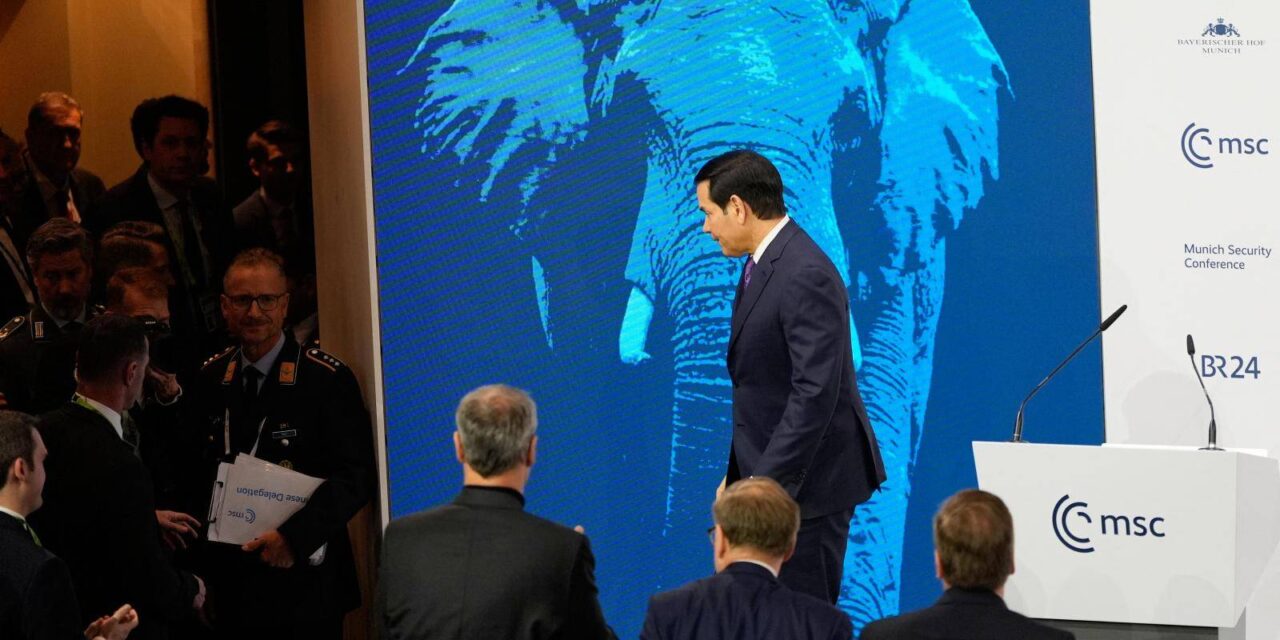
US Secretary of State Marco Rubio leaves after speaking at the conference on 14 February 2026 // Photo by Alex Brandon / POOL / AFP via Getty Images
Contemporary European thinking is underpinned by the view that all that is needed is to simply sign a ceasefire, stop the fighting — and that will be sufficient. At the same time, after the ceasefire Europeans will continue to supply weapons to Ukraine and possibly even send their troops there and there will be no political settlement. It would appear that nobody in Europe wants to understand that any peace agreement must address the underlying causes of the war. However, this issue is not even broached today.
The Munich Security Conference in 2026 imparted an even more depressing impression than the one in 2025 — back then there were still expectations that the parties were interested in discussing a way out of the tragic impasse after three years of war4G. Yavlinsky. Munich Plan // Official website of politician and economist Grigory Yavlinsky. 15 February 2025. Access (checked on: 27.02.2026).. The fact that there was no such discussion at the time could be attributed to the seismic earthquake caused by the change of course in the attitude of the new US administration to Europe and the aggressive speech delivered in Europe by US Vice President J.D. Vance5JD Vance stuns Munich conference with blistering attack on Europe’s leaders // The Guardian. 14 February 2025. Access (checked on: 27.02.2026).. However, such expectations were no longer on the cards in 2026: today one must acknowledge that notwithstanding the total impasse on the Russian-Ukrainian front line and even against the backdrop of conversations about a ceasefire, the European political establishment is not capable of holding a constructive discussion on how to end the war which is continuing with every passing day for the fifth year already to claim more and more lives.
MISSED OPPORTUNITIES
In these circumstances what is the outlook going forward?
At the end of the 1980s, when Mikhail Gorbachev was still in power, the idea of a Common European Home started to be developed. In 1990 the Paris Charter for a New Europe was signed, a Treaty on Conventional Armed Forces in Europe (CFE) was concluded, the joint declaration of 22 states was adopted (members of NATO and the Warsaw Pact Organisation), which proclaimed that security was indivisible and referred to sovereign equality and a Europe without borders.
And at the same time the United States started NATO’s expansion to the east, which became extremely destructive for the integration processes in Europe, as it abolished the entire project of the common European indivisible security architecture, which did away with borders6Meeting of the US National Security Council in 1991, where the Grand Bargain programme was discussed, is a case study of the politics of the White House at that time. See the Declassified Materials of the US National Security Council: How Yavlinsky’s Programme might change the course of history // Official website of politician and economist Grigory Yavlinsky. 22 April 2025. Access (checked on: 27.02.2026)..
Initially Boris Yeltsin and the Vladimir Putin talked in different formats about Russia’s possible accession to NATO7Cable from U.S. Embassy Moscow to State Department, “President’s Dinner with President Yeltsin,” [January 13], Novo-Ogarevo, January 14, 1994 // National Security Archive. Access (checked on: 27.02.2026); Putin Does Not Rule Out Russia’s Accession to NATO // Lenta.ru. 5 March 2000. Access (checked on: 27.02.2026).. In 2001 Putin proposed the creation of a Russian-European anti-missile defence system8Putin Proposes the Creation of a Common Europe Anti-Missile Defence System // Nezavisimaya Gazeta. 7 June 2000. Access (checked on: 27.02.2026).. In 2005 a set of roadmaps on four common spaces between Russia and the European Union was adopted9Russia and the European Union Have Approved the “Roadmaps” // RBC. 10 May 2005. Access (checked on: 27.02.2026).. In 2008 attempts were made to agree on integration efforts regarding a common neighbourhood and a common European security architecture between Russia and the European Union10Dmitry Medvedev Proposes the Creation of a Common European Summit to Launch the Development of a New European Security Treaty // Official website of the Russian President. 5 July 2008. Access (checked on: 27.02.2026).. In 2010 Putin proposed a programme on a joint future to Europe11V. Putin Proposes a Programme on a Joint Future to Europe consisting of Five Points // RBC. 25 November 2010. Access (checked on: 27.02.2026).… However, nothing came of it — Western politicians rejected much of it, drew a discreet veil over such matters or violated them almost immediately after their signing. The European bureaucracy’s virtual refusal to explore political cooperation and promising options for interaction with Russia under difficult conditions contributed to the stagnation of the liberal democratic political order that emerged in Europe after World War II, hindered the fundamental expansion of this model’s influence, and impeded modernization. In Russia, this only further strengthened the anti-democratic and authoritarian political regime, which was a direct consequence of the complete failure of the 1990s’ reforms. The Kremlin’s propaganda justification for its anti-European policy was the opposition of Russia to European civilization and fantasies of an alternative «Eurasian» model12G. Yavlinsky. A Conscious Choice? // Official website of politician and economist Grigory Yavlinsky. 6 February 2015. Access (checked on: 27.02.2026); G. Yavlinsky. The Path That Wasn’t There // Novaya Gazeta. 19 October 2015. Access (checked on: 27.02.2026); G. Yavlinsky. Russia-2022: Underlying Causes // Official website of politician and economist Grigory Yavlinsky. 2 July 2022. Access (checked on: 27.02.2026). . In 2014 the conflict started in Ukraine, there was an attempt to find solutions, but the Minsk Accords signed by Ukraine and Russia and approved at the European Union and the UN Security Council turned out on closer inspection to be humbug13Merkel Declared the Minsk Accords Were an Attempt to “Give Ukraine Time” // TASS. 7 December 2022. Access (checked on: 27.02.2026).. In 2022 the Russian regime launched the special military operation — and there was even a chance to reach agreement subsequently, but the Istanbul process was deliberately undermined14Boris Johnson Talks about his Participation in the Breakdown of the Negotiations on Ukraine // Lenta.ru. 18 March 2025. Access (checked on: 27.02.2026)..
A PACT ON THE FUTURE
The key issue today concerns the future — can we expect simply a temporary respite in the confrontation between Russia and the West which has escalated over the past 30 years, which might be followed by a major war, or is it still possible to change course and try to move in what is effectively a different direction?
So a change in the direction of travel requires something more fundamental than simply attempts to resolve the issue of NATO’s expansion. A pact on the future is needed. And whereas in the past such an agreement should have only concerned the root causes of the actual conflict in Ukraine, now the understandings must cover the entire common European security system and even more broadly the prospects of Russian-European co-existence against the backdrop of the change in US politics and China’s global expansion. In the new circumstances, when America is distancing itself from Europe, while the goals espoused by the European Union and NATO are becoming virtually indistinguishable, Ukraine’s possible accession to the European Union looks like a version of accession to NATO.
All one needs to do is to listen to the speeches in Munich in February 2026 delivered by Germany’s Chancellor Friedrich Merz and the Prime Minister of Great Britain Sir Keir Starmer: they only believe in the continuation of the fighting in Europe, and the launch, as they hope, of a new cold war and the restoration of the “iron curtain”15Ukraine war briefing: conflict could end if Russia is economically or militarily ‘exhausted’, says Germany’s Merz // The Guardian. 14 February 2026. Access (checked on: 27.02.2026); Europe must be ready to fight, PM tells Munich Security Conference // BBC. 14 February 2026. Access (checked on: 27.02.2026)..
The scale of the confrontation is expanding before our very eyes — everyone can see how the problems of the Arctic, the Baltic Sea and Kaliningrad are being militarised. If we fail to change the course of confrontation, if we fail to investigate the root causes of the current conflicts, the confrontation will simply escalate.
At the same time it is clear that as a result of its refusal to buy cheap Russian energy, Europe has embarked on a period of economic recession: enterprises are closing, the cost of life is increasing. And in the process Europe is also becoming poorer — or at the very least, it is deindustrialising and is plummeting to long-term economic decline. Today Europe is to a large extent paralysed. For the sake of their own benefit Europeans must build normal relations with Russia: open their borders so that people can travel freely, buy Russian commodities. We must facilitate the growth of the European economy and restore ties between people throughout Eurasia. And if we are talking about the best future for Ukraine, this would be contingent on closer relations with Europe, with the simultaneous establishment of normal relations with Russia.

Europe’s Defense // Illustration
At present, however, there are no signs at all that Europe intends to make the transition to the new structure of the modern world. All of Europe’s foreign policies pursue one single goal — to defeat Russia. And as membership of the European Union, as we have already mentioned, equates effectively to membership of NATO, it would be advisable to seek a far broader format of contractual relations. We will need, as they sometimes say, inclusive diplomacy. Europe must start to speak seriously with Russia.
And, judging on the statements issued, it should be understood that such events as the Munich Security Conference no longer represent the space for diplomatic work aimed at mitigating the tension or for brainstorming that seeks to resolve common problems. Negotiations and discussions are supplanted by personal and collective PR. Given that the long and inarticulate speech delivered by Donald Trump was the key event of the Davos Economic Forum held in January 2026, one might talk about the profound crisis of such meetings which are taking their leave together with the passing era. We must find new formats and create new institutes that are adequate to the time and challenges that we face.
One could sense in the speech of US Secretary of State Marco Rubio at Munich intentional complementarity after the contemptuous criticism of Europe unleashed in the speech by J.D. Vance at the same venue a year ago16Secretary of State Marco Rubio at the Munich Security Conference // U.S. Department of State. 14 February 2026. Access (checked on: 27.02.2026).. Rubio’s tone delighted Europeans, but it goes without saying that this did not remedy what had been broken within the transatlantic alliance when Donald Trump declared in January 2026 that he needed Greenland, which is managed by Denmark, as payback for the many years when America protected Europe. Even more so, when the US Secretary of State did not say anything meaningful about the current situation and prospects of the Russian-Ukrainian conflict.
After Munich Rubio made landmark visits to Slovakia and Hungary — countries, whose leaders admire Trump, are friends with Russia and are caught up in constant conflict with the administration of the European Union. In Hungary Rubio supported the current Prime Minister Viktor Orban, stressing that his success in the forthcoming elections there would be “important” for the national interests of the United States of America17Rubio praises Orban and Hungary ahead of crunch election // DW.com. 14 February 2026. Access (checked on: 27.02.2026)..
The first step on this path requires an awareness that there is an alternative to the current impasse: mankind has constantly been confronted with a choice between different turning points and crossroads when the competence of leaders to discern the path to positive changes has played a key role. Moreover, the ability to perceive an alternative direction of history has always been particularly important during those transitional periods when the future seemed uncertain and frequently elicited fear and consternation.
A NEW COMMON SPACE
However, this is a lie, we have always had a choice: mankind has constantly been confronted with a choice between different turning points and crossroads when the competence of leaders to discern an alternative has played a key role. Moreover, the ability to perceive an alternative direction of history has always been particularly important during those transitional periods when the future seemed uncertain and frequently elicited fear and consternation.
It is crystal clear today that the key questions that need to be addressed in each of the current global conflicts have nothing to do with the situational disposition of forces on the battlefield and the control of each square kilometre by the adverse parties. No, the following constitute the key questions: what should be the basis for building the future and what should serve as the foundation of future relations? And that is why the only alternative to sleepwalking our way to catastrophe, the adoption of real steps to extricate ourselves from the chaos and the start to move towards a new era requires us to answer the questions of how and where we want to go.
Each individual, the preservation of his or her life, the observance of rights and freedoms, as well as key development interests — all this should not only be declared, but also institutionalised in the state system and be placed at the centre of international and national European politics. The construction of a new common space on such foundations is key to our advance towards a normal future.
And if we are talking about Russia, then European integration is a solution to the crisis facing our country. This is a complex, protracted and multi-stage process. However, historically, culturally and in terms of values, Russia is a European country, while the history of European civilisation is inextricably linked to Russia. Fortunately, such historical reality is beyond the control of the Kremlin, EU bureaucrats or any other officials and transient political figures. We are talking here about civilisation. Understanding this factor will enable us to advance to the future and the promise of a Big Europe, all the way from Lisbon to Vladivostok. The path will be very hard and it may well take two or three decades to reach this destination. At the same time, however, this is the only real strategy that will make it possible to preserve Russia, Ukraine, Europe and the world.
PART TWO. CHAOS
LOST IN THE PAST
The world is undergoing radical change. Whereas discussions about changes in the world order several years ago were the preserve of only a few forward-looking experts, today the rapid collapse of the previous world order is discernible to virtually everyone.
The bloody confrontation between Russia and Ukraine, the catastrophic exacerbation of the situation in the Middle East, the wide-ranging escalating political crisis in Europe, the politics of US President Donald Trump — all these factors draw the line on a world order which had existed for almost eight decades.
And this is not simply a crisis of the old world where something new is born and carves out a way forward. In the evolving circumstances, the emergence of something new, rational and promising is contingent not only on fundamentally different and new leaders, but also requires above all a novel political quality that may serve as guidance for politics and social life. In the current circumstances changing at lightning speed, former leaders try on the cuff to replace institutions that are already defunct with political models and structures from the same period when they themselves had lived. Consequently, the crisis does not lead to renewal, but instead transitions into chaos.
We can only extricate ourselves from chaos if we first understand what is the desirable, or to be more accurate, the strategic perspective that is required objectively to save mankind. Accordingly, we need to understand the meaning and image of the future that we must aspire to create and identify the necessary benchmarks. To put it more simply, we can extricate ourselves from the chaos once we understand where we want to go and why.
Unfortunately, for the time being, there are no signs that any of today’s international politicians are aware of this fact and take this into account in their actions. The overwhelming majority of today’s statesmen and diplomats (incidentally, this also applies to the public at large) are lost and wedded to the past and simulate activity that is devoid of any meaning whatsoever. As a rule, they behave as is customary and try to adapt to developments or in actual fact to all intents and purposes do nothing, simply hoping for the “bad” times to end.
IMMERSION IN CHAOS
Today it can be acknowledged that the era of globalisation has ended. Global institutions and forums (such as the UN, the World Bank, the WTO, APEC, etc.) have stopped developing common rules and projects. Some of them have been discredited by charges of political bias and even corruption, while the inefficiency of these organisations has become clear. The world’s political elites no longer believe in the future of these institutions and are for that reason already questioning whether it is expedient to continue supporting and maintaining these structures. In January 2026 Donald Trump published a presidential memorandum on the White House’s website, which stipulated that the United States was withdrawing from 600 international organisations (including 31 operating under the aegis of the United Nations), as they “are contrary to the interests of the United States”18Withdrawing the United States from International Organizations, Conventions, and Treaties that Are Contrary to the Interests of the United States // Official website of the Office of the Administration of the US President. 7 January 2026. Access (checked on: 27.02.2026).
Brakes have also been put on the activities of regional multilateral institutions: their work on unifying rules and eliminating barriers to facilitate the cross-border movement of production has started to slow down and also be blocked. For example, the idea of a pacific free trade zone was effectively abandoned back in the 2010s. This process has even started to become manifest in member states of the European Union where the bureaucracy has been focussing on perfunctory geographical expansion, instead of improving the performance of the EU’s multilateral institutions.

CagleCartoons.com. 20 August 2025 // By Arcadio Esquivel
As global and even regional cooperation mechanisms fall apart, the idea of returning to “national interest” as the key component of international politics is gaining momentum. Reciprocal property guarantees are being eroded: this is happening through unilateral sanctions and restrictions on the ownership rights of foreign investors. Sanctions imposed against certain parties (based on a broad meaning of the word, including the arbitrary regulation of activities and politically motivated judicial prosecutions) are tools that are becoming widely used. This process (when the rights of foreign parties are secondary to national interest) is no longer perceived as a contravention of fundamental principles.
Politically, there has been a precipitant dissipation, if not collapse, of virtually all the traditional ideologies (libertarianism, liberalism, right-wing conservatism, social democracy, radical social theories, etc.). Initially there had been attempts to implement environmental projects related to global warming in the freed-up niches and transform assessments and understanding of the principles of sexual orientation and gender self-identification. Subsequently, extremely simplified ethnic and national consciousness, as well as so-called consumption options, came to the fore. However, the crux of these processes is still the same: political ideology is being supplanted by potential aspects of various platforms, but minus a foundation. At the same time, as a rule the new agenda does not make room for the rational conceptualisation of the desired structure of society. Everything is focused on triggering emotions, inciting ressentiment and restoring the former “golden age”.
The erosion of rational content from public politics has resulted in the dilution of the key objective of ensuring the survival of society through the search for the collective interest or the balance of interests. This objective is being replaced by the instant satisfaction of desires, where the goal is to adapt individually to changing circumstances, which also leads to political entropy — a new systemic phenomenon of modern civilisation19G. Yavlinsky. Political Entropy. Мoscow, Medium. 2021..
At the same time, instead of replacing one structure of public consciousness with another one, we are observing a breakdown of the formats and structures, the chaotization of public consciousness, with emotional reactions supplanting reflection and the rational conceptualisation of developments.
THE INDIVIDUAL HAS BEEN SIDELINED
A vast array of factors have emerged in international politics over the past quarter of a century which have to all intents and purposes been disregarded by the ruling elites — both politicians and economists. Acting in accordance with old templates and standard models, the elites were unable to respond adequately to new challenges (for more details on the opportunities to attain a qualitatively new level that were missed during these 25 years, see my article “There is Only One Solution20G. Yavlinsky. There is Only One Solution // Official website of politician and economist Grigory Yavlinsky. 29 September 2025. Access(checked on: 27.02.2026).). And this concerns first and foremost such factors as the erosion of the value-based substance of politics and the impact of new technologies.
In actual fact, this phenomenon could also be observed back in the 1960s when differences between the values being declared and practical actions began to manifest themselves more and more in the actions of leading politicians and representatives of business and other elites. This phenomenon is known as realpolitik. At the start of the 2000s the consequences of this cynical policy were already extremely perceptible in the global economy21G. Yavlinsky. The Recession of Capitalism – Hidden Causes (Realeconomik). Мoscow, HSE, 2014.. Shortly afterwards quantity was transformed into quality, and values deemed sacrosanct in the past were called into question — in particular, human rights and freedoms, including the right to life. In a world which is divided more and more into “us” and “them” (based of the most varied characteristics), these values stop being perceived as universal and unconditional.
All the talk is only about reinforcing military potential and the need to build up defence capabilities in order to prevent an attack “which is already being planned”. However, this is also the path to war — either to the multiplication of regional conflicts or to global confrontation. It would appear that nuclear weapons are the only deterrent which have to date prevented the start of such a world war. Nobody knows the extent to which such guarantees are reliable and promising, but:
- Firstly, the actual use of nuclear weapons would be fatal for human civilisation;
- Secondly, as well as the other institutions of the previous era, nuclear arms control treaties, nuclear test ban treaties and the treaty on the non-proliferation of nuclear weapons are being destroyed, and once they collapse definitively and nuclear weapons start to proliferate rapidly around the world, a qualitatively new situation will emerge and the likelihood of the tactical use of nuclear weapons by states or terrorists will increase significantly.
In addition, we can expect to see global and regional disasters related to climate change, the appearance of new dangerous viruses and other unexpected phenomena, while it is utterly pointless to talk today about any joint international efforts to prevent and overcome them.
Even if we manage to avoid disasters — nuclear, environmental or epidemiological — in the foreseeable future we will still have to deal with a splintered and fragmented world, with each segment driven by its own goals and survival tactics. Strategically, however, this world not move forward, but will instead drift, decaying as a consequence of entropy. Life in this world will be structured according to the principle “you will die today, while I will die tomorrow”, in other words, short-term domestic interests will take precedence over long-term common objectives.
In addition, it is important to consider as well the extremely serious factor of new technologies and the role of artificial intelligence, which poses no less a potential danger than nuclear weapons.
The headlong technological evolution over the first two decades of the 21st century led to a gulf between human capabilities and technological achievements. Against this backdrop, technocrat billionaires who de facto own the biggest technology assets have to all intents and purposes usurped vast sectors of the lives of modern man — social networks, artificial intelligence and robotics. The profound crisis of outdated political models, the exclusion of human values from politics and the attempt to supplant them with technological achievements will lead initially to populist ochlocracy (ochlocracy implemented through populist mob rule)22G. Yavlinsky. In-Between Times: On The Titanic // Official website of politician and economist Grigory Yavlinsky. 23 December 2024. Access (checked on: 27.02.2026)., and then to the enslavement of the individual (the rejection of democratic models in politics and social life and the establishment of new rules to be dictated by the new technocrats).
In this scenario we can expect a society of artificial intelligence and high technology slavery. The new technologies will continue to develop and advance, while socio-political issues will all be relegated to the background, the position of the individual in the new technological realities will be exacerbated by mounting electronic control, society will be torn asunder and mankind will transition to all intents and purposes to a new form of slavery, albeit a soft version, without any real iron chains. Instead of an image of a future for all mankind, the new world offers real prospects with advantages only for the chosen few. In the case of everybody else — virtual toys and the maximum possible exclusion from any influence on actual socio-political processes.
WHERE SHOULD WE GO AND WHY?
A very special moment is coming when the disintegration of the previous world order built after the end of World War II will trigger the need and opportunity to consciously lay the foundations of a new world. And now is the time when we must start thinking in categories of the future and seek out fundamentally new opportunities for positioning and promote the construction of a new world.
Those countries, state and political leaders that become aware of this fact and act, relying specifically on their vision of the future, will be able to assume leading positions in the new world. Furthermore, this will not be due to the sizes of their territories or the volumes of natural resources at their disposal, but instead thanks to human qualities — the ability to think creatively and plan a value-based future.
That is why it is not only possible, but also necessary to talk right now about matters that the overwhelming majority of people believe will be hard to implement or even impossible in the current realities. And this is the objective of a true modern political leader able to discern what is not perceptible to others and capable of leading others.
On the other hand, it goes without saying that these should not be pie in the sky fantasies on “what it would be fun to do”, but instead a specific, realistic and convincing plan. Furthermore, if we are talking about the future, about the year 2050, we need to start immediately – we need to contemplate what we can offer and do this now so that truly positive changes actually occur during the next quarter of a century.
For it is namely long-term thinking which offers an opportunity for the positive development of Russia’s future. However, if we are to make the most of this chance, we must set as the main goal of any political changes the modern development of the country that is in line with the coming times and ensures the actual prosperity of the country’s citizens.
And when I refer to the prosperity of citizens here, these are not empty, bombastic words. It has become clear by the second quarter of the 21st century that the modern state should serve the individual, and not vice-versa. All state institutions should work in the name of and for the benefit of the individual.
Today, at the start of 2026 it is clear that restoring human values to politics and placing the individual at the centre of politics represent the only possible construct of the political and social structure in the 21st century which will not tolerate the quashing, oppression or enslavement of the individual.
Once we understand these threats and risks, we will already have to confront today the new forms of technological autocracy: create systems to ensure state and public control over the dissemination and implementation of new technologies in our daily lives. Such control should be based specifically on the same principles as the entire socio-political construct in the 21st century: the new technologies should serve the individual, and not vice-versa.
The life of the individual, his/her rights and freedoms, should become the central, defining criteria for the establishment of all political, social and technological models in the modern world. The resolution of every single political issue will derive from this understanding — from the termination of military conflicts to Russian-European integration. For we see the future of Russia and Europe specifically in such integration processes where the individual is assigned a central role.
EUROPE LAGGING BEHIND
These days Europe — at one point in the past the source and centre of humanist values — is drowning in crises.
Until recently Europe’s foreign policy revolved around the principles of European Atlanticism. One might say that even today the diplomacy of the European Union, in defiance of reality, is trying to adhere steadfastly to the same principles. However, even with this strategy Europe is no longer a global centre or even an equal component of the dual American-European world.
After the return of Donald Trump to the White House, the United States has disengaged from Europe. Now Europeans are merely a military political satellite for Washington. Today, however, even the future of NATO itself is already being called into question.
At the summit of the North Atlantic Alliance in the Hague in June 2025 Europe’s representatives did all they could to gratify Trump. In particular, they agreed to increase defence expenditure to 5% of GDP, but not immediately — only by 2035. However, the National Security Strategy of the United States published half a year later23National Security Strategy of the United States of America. November 2025 // Official website of the Executive Office of the President of the United States. Access (checked on: 27.02.2026)., taken in conjunction with Trump’s speech at the World Economic Forum in Davos in January 202624President Trump Delivers a Special Address to the World Economic Forum // Official website of the Executive Office of the President of the United States. 21 January 2026. Access (checked on: 27.02.2026)., demonstrate that neither flattery, nor other attempts to accommodate the American President work. Furthermore, both in the new security strategy and in his speech at Davos Trump unleashed for the first time unprecedented American criticism on the European Union. Moreover, the targets of this criticism are not only the Brussels bureaucracy and policies of the European Union, but in fact everything that constituted the substance of European development in the 80 post-war years. For example, according to the new national security strategy of the United States, it should prioritise “Enabling Europe to stand on its own feet and operate as a group of aligned sovereign nations”, and also “Cultivating resistance to Europe’s current trajectory within European nations”25National Security Strategy of the United States of America. November 2025 // Official website of the Executive Office of the President of the United States. Access (checked on: 27.02.2026)..
The break-up of European Atlantic unity should not be considered a temporary episode or a geopolitical aberration, but should instead be perceived as one of the dominant traits of the future world — regardless of whether this concerns Trump’s term of office or post-Trump regimes. The withdrawal of the United States from the European continent is not simply a political game or economic rivalry. This is a far more serious and substantial shift than it may appear at first glance. Throughout the past three centuries at the very least Europe was the leader and political core of civilisation. At the same time, Russia has been an inalienable component part of the European world. In the first half of the 20th century Europe has rapidly lost ground: first of all, World War I, which was catastrophic for European politics, then the appearance of the USSR and the establishment of Nazi Germany, and as a result of the above, World War II which was so destructive for Europe. However, after experiencing such a catastrophe, European nations started building all together literally from ruins, with the participation of the United States, a contemporary European Union. Decades were spent on its construction. The price paid by the peoples of Europe to understand how they could and must live together ran into tens of millions of lives.
However, today the European world is immersed in a crisis that attests to the end of the post-war era which lasted eight decades. It is becoming more and more likely that the threat that Europe as it stands today may lose out competitively to America and Asia and may be transformed into the backwater of the world with a declining indigenous population, which will be ousted significantly by migrants from other regions, will be materialised.
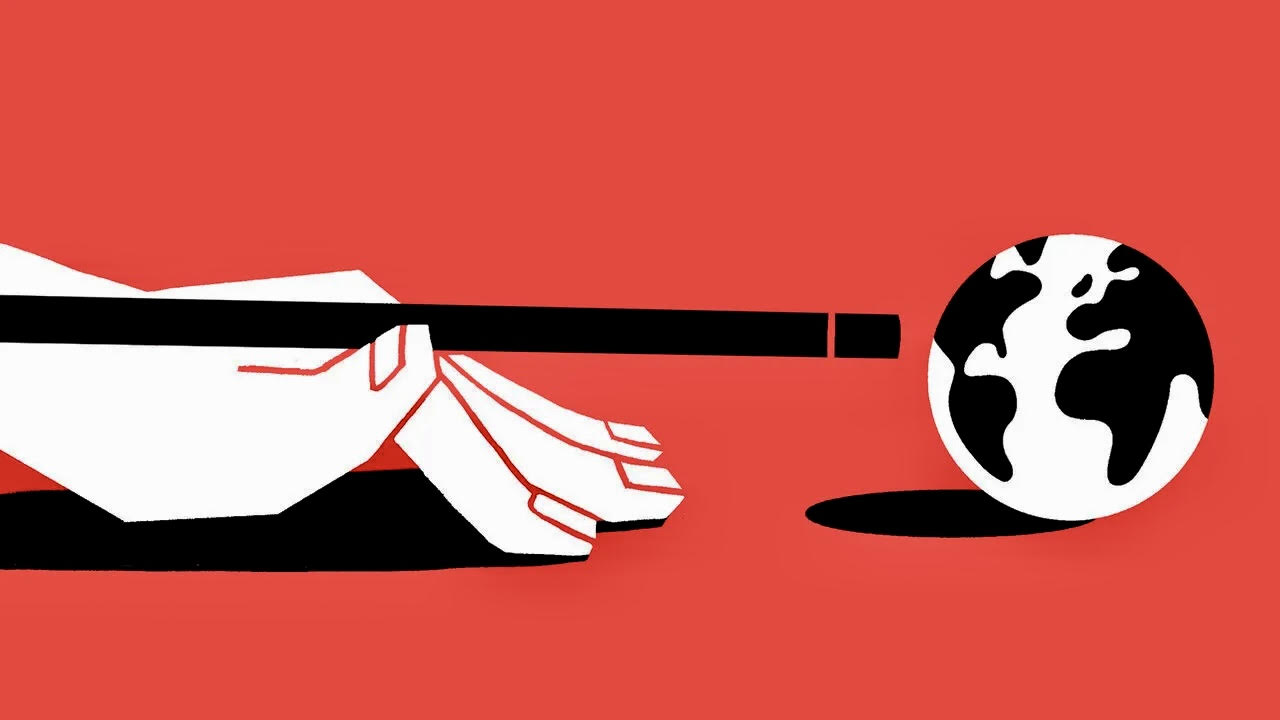
Illustration by Ben Hickey, The Economist
We can see for ourselves how Europe will stop being the custodian and transmitter of the values that we call European. It is true that the events in Ukraine are a horrific tragedy, regardless of the underlying causes of such developments (although it is also extremely important to understand and analyse the causes of the conflict: in the case of Russia, it was the failure of the economic reforms of the 1990s attributable to the egregious errors of the country’s leadership and, as a result, the lack of a democratic state, independent judiciary, parliament, mass media, as well as the creation of an authoritarian corporate system managed by one person; it goes without saying that the role played by Ukraine and the West in the catastrophe also needs to be duly considered26G. Yavlinsky. Russia-2022: Underlying Causes of the Current Situation. Мoscow, Medium. 2022.). However, the position adopted by the West and Europe, in particular, regarding a ceasefire between Russia and Ukraine for virtually all the four years of the military actions, was a direct contravention of European values.
Although it is specifically Europe that could and should have added substance to this process, as both Trump and his administration are extremely removed from Ukrainian, Russian and even European realities.
EUROPE, RUSSIA AND THE INDIVIDUAL
The only strategic option for contemporary Europe to extricate itself from the current crisis involves integration with Russia based on common European values, first and foremost, the sanctity of human life, personal freedoms, dignity, education and the creative development of the individual, as well as real institutional democracy.
It is clear that the enfeebled European economy is in dire need of Russian resources. For it is specifically by working together with Russia that Europe will be able to overcome its growing technological lag behind North America and China. Moreover, the war in Ukraine has made it abundantly clear that the military and economic threats emanating from Russia will prevent the creation of an effective European security structure: the perception of Russia as an enemy is a stance that is ruinous for Europe.
Is a real sustainable strategic partnership between Europe and Russia possible? Today this question may appear inappropriate, may cause consternation or even be met by rejection. Moreover, the modern European political establishment has declared unambiguously that such a partnership would be categorically impossible. However, the historical reality is such that there is simply no other solution either for the future of Europe or the future of Russia. Only the readiness for partner relations and mutual rapprochement, taking into account the role of modern technologies in socio-political life, can promise peace on the European continent.
Understanding of the above is particularly important in the context of the critical social processes in Europe. The politics of multiculturalism have come to a standstill. Millions of Muslim migrants from the Middle East and Africa have also been unable to integrate with European Christian civilisation. In the case of a number of European regions, this has become a real demographic and cultural threat, while in some European countries one can even talk about the erosion of state sovereignty in connection with the vast influx of migrants. And in this context Russia’s rich centuries-long experience of the co-existence of Christianity and Islam may help Europeans find responses and solutions to the dead-end problem they are encountering with migrants. Here too Russia’s cultural proximity with Europe can play a decisive role.
At present the Russian-Ukrainian conflict would appear to be an insurmountable obstacle to Russia’s rapprochement with Europe. However, the point is that the fundamental resolution of this confrontation can only be found through Russian-European integration. For neither a short-term, nor a long-term ceasefire, even if it is an indispensable condition and exigent requirement on the path to peace, can resolve the conflict. Similarly, it cannot be resolved by either territorial concessions, or obligations and guarantees spelled out in contracts. The Russian-Ukrainian conflict can only be resolved by eliminating its underlying causes: in Russia this was the failure of the reforms of the 1990s with all the ensuing consequences in terms of the lack of an independent judiciary, parliament and mass media, as well as Bolshevism and Stalinism which have not been overcome; in Ukraine it was modern nationalism; in the West it was due to a total lack of political understanding of Russian and Ukrainian history, cultural and national specifics and the politics of the past three and a half decades and, as a result, disregard for interests of principled importance for the future of Russia and Ukraine.
The causes should not be eliminated through mere statements, but instead through institutional transformations, furthermore, specific transformations. And here one can recall the experience of post-war Europe when the previous enemies in World War II already started building a joint future several years after a deadly confrontation — which subsequently became the European Union. Yes, it goes without saying that the basis of the joint construction was the complete and unconditional military defeat of one of the warring sides. In today’s realities such a situation is impossible. This is the principled difference between the current events and what happened in the 20th century. This needs to be understood and taken into account. And this is the key difficulty. However, if we do not look for a way to resolve this problem — if we do not try to eliminate the underlying causes of the biggest military confrontation in Europe after World War II, if we do not try to meet each other halfway — then the world can expect a war of such a magnitude which will usher in the end of all modern civilisation. And no new technologies, no artificial intelligence, no Musk or Thiel, will prevent this final catastrophe.
In these circumstances dedicated political multilateral democracy, transitioning into a new quality of European and global politics, is the only way to preserve not only Europe, but also possibly human civilisation as a whole. This is the categorical imperative for building the future.
Accordingly, we need to find a path to the future, to try to make sense of the lessons of history, to combat emotions and caprices in politics, to reject vengeance for the past. However, as a start, European, and in particular Russian politicians, must try to discern the desired future and attempt to find a path to that end goal. Politicians, who do not understand the future, will not be able to extricate their peoples from the impending chaos.
CRISIS OF LONG-TERM VISION
At present understanding and describing the future are not part of the political agenda in the United States, Europe and all the more so in Russia. It stands to reason that the refrain of the populist ochlocracy in a number of countries in different languages and represented by different elements today is a repeat of Trump’s Make America Great Again.
In the proclamation to Make America Great Again, the key word is “again”, which implies a return to the past. Such a view and political concept are fraught with dangerous consequences. An inability to see the future is not a new phenomenon. At the same time, however, recently strategic blindness has become an extremely widespread affliction. As a result, uncertainty is the main trend of the time: unpredictability, the inability to make any projections, a lack of understanding of the future even in the short or medium term.
It is namely due to the lack of forward thinking that the opportunities to build a safe world consciously and systemically which opened up after the end of the cold war were missed:
- the countless billions freed up as a consequence of the end of the arms race were not allocated to global development, first and foremost, to humanitarian, educational and other projects for “third world’ countries, to a decrease in global inequality;
- Russia’s post-Soviet modernisation with the approval and proactive participation of the West failed;
- the hopes for the European integration of Russia, Ukraine, Belarus and a number of other countries of the post-Soviet space, which had been separated from Europe by the “iron curtain” project, did not materialise;
- cooperation projects in the area of security, such as the creation of an anti-missile defence system with the participation of the United States, which had been discussed at the highest levels, were not brought to fruition27President Vladimir Putin held negotiations with NATO Secretary-General George Robertson // Official website of the Russian President. 20 February 2001. Access (checked on: 27.02.2026)..
Instead, in recent years disintegration processes started in Europe itself, such as Brexit, the accession to power and consolidation of the positions of Eurosceptics and far right-wing forces in Hungary, Slovakia, Czechia, Poland, Italy, Austria, Germany, France and the Netherlands.
Political entropy has also intensified on the other side of the Atlantic Ocean. The first wake-up call was Trump’s first presidential term, which culminated in the storm of the Capitol in January 2021. This was followed by the Biden administration when the democrats were unable over four years to select an alternative to the 82-year old candidate by the next elections. Trump’s triumphal return to the White House established a diagnosis for contemporary American and global politics — a populist ochlocracy, in other words, the victory of the mob with the assistance of information technologies.
WORLD OF UNCERTAINTY AND A NEW CHANCE
One can dispute the role and influence of the United States in the world today. However, it is hard to object to the tenet that the current US President is virtually determining at his sole discretion the political agenda in today’s world. However, the problem is that in so doing, Donald Trump himself does not have his own vision of the future.
Naturally, certain outlines of Trump’s politics can be designated. His presidential campaign was performed under the slogan “America First”. However, the first year of his presidency already demonstrated that a course that prioritises national interest does not necessarily imply isolationism. In his second presidential term Trump is gravitating towards a new, expansive understanding of the United States — when America, on the one hand, refuses to assume responsibility for the whole world and focuses on its national interest, but on the other hand does not withdraw behind its borders, developing zones of American interest both on adjacent territories and in the Western hemisphere as a whole, as well as in extremely remote areas. Hence the “special operation” in Caracas, and the claims to Greenland and the Panama Canal, and conversations on Canada as the country’s 51st state. And here too we see the Iran war and an attempt to retain influence in the Middle East as a lever to manage global oil prices.
The new National Security Strategy of the United States de facto merely consolidates the course that Trump has already charted: “The days of the United States propping up the entire world order like Atlas are over. We count among our many allies and partners dozens of wealthy, sophisticated nations that must assume primary responsibility for their region”28National Security Strategy of the United States of America. November 2025 // Official website of the Executive Office of the President of the United States. Access (checked on: 27.02.2026).. In this way Trump is intuitively trying to probe the contours of the future world order.
However, the so-called MAGA concept (invoking “Make America Great Again”) is addressed to the past, and not to the future. It is no accident that the National Security Strategy of the United States of 2025 appeals to the Monroe Doctrine from two hundred years ago when the fifth US President James Monroe declared the need to protect the American continent from the encroachment of European colonisers. This is an attempt to move forward, while looking backwards. Technically, it goes without saying that any such advance is possible for a while, but is associated with traumatic bumps in the road and is fraught with the risk that you end up at an impasse.
For the time being Trump is assuming the role of destroyer, and not creator. He is driven by immense resentment against an unjust world where the United States is no longer the biggest economy. Trump attributes this development to deception and theft. He is determined to rectify the situation, but the US President has no vision of the future. He relies instead on his business intuition. This underpinned the appearance of the “Trump version of the Monroe doctrine” where the main point is to create conditions for unlimited business.
The US operation in Venezuela which opened the year 2026 and shocked the entire world is an illustrative example of such policy. It is clear that the abduction of the Venezuelan President Nicolás Maduro was driven by the unabashed demand that the US control the largest oil reserves in the world. At the same time, the political future of Venezuela’s 30 million population, the prospects for the country’s economy and outlook for the lives of its citizens, all these factors remain unclear. And most importantly, these issues are not even part of the agenda of the “liberator of the Venezuelan people” Donald Trump. Instead, the social media networks of the US President display his photograph signed “current President of Venezuela”. Incidentally, the issue of the future of the Gaza sector, including the disarmament of Hamas, has in practical terms gone nowhere, even though Trump took credit a long time ago now for the settlement of the conflict in the Middle East (at present the high-profile initiatives on creating a Board of Peace for Gaza and the graphic presentations of upmarket Palestinian resorts bear no relation whatsoever with the practical aspect of the matter). However, in actual fact similarly this issue is also not discussed — neither the press, nor the representatives of elites dare to put such awkward questions to Trump.
The chaotic nature of Trump’s self-confident actions, when neither he himself, nor the current US administration as a whole, has any serious vision and understanding of the situation in those areas where Americans are currently try to play a role, is dangerous in itself. The illusory birth of some new world has been created, false hopes for the future arise when one can count on something, make plans, draw forecasts… However, in reality there is no new world, but simply the same chaos.
Such inconsistent and superficial politics might well end up devaluing what are in actual fact important shifts: first and foremost, this concerns an end to the fighting between Russia and Ukraine. In a bid to engineer a ceasefire in Ukraine, Trump did in fact stumble upon the underlying principle for preserving the future — bring an end to the loss of lives at any cost. Regardless of whether Trump understands this or not, any continuation of the war leads to a dead-end, the negation of any prospects, first and foremost, for Ukraine, and subsequently for Russia and Europe, and if we factor in the nuclear issue — possibly for the whole world. By contrast, the end of the military conflict could become the starting point for the elaboration of the global politics of the future — and mark the first step on the path not only to peaceful life for Russia and Ukraine, but in general for a new European peace. In order to turn such a prospect into reality, we already need to do our utmost today to achieve the European format from Lisbon to Vladivostok.
PART THREE. TECHNOLOGY RISKS
THE DIGITAL CONTROL
Throughout the entire 20th century and even in the first 10-15 years of the 21st century mankind perceived progressive forces in technologies: such developments paved the way to information which has been used to make scientific discoveries, implement innovations, alleviate harsh physical labour, simplify daily life, break up inefficient monopolies, guarantee safety in many areas of life and fight crime.
The appearance of social networks in the mid-2000s laid a train wreck waiting to happen due to the faith of people in technological progress. Hundreds of millions of Internet users all over the world have started transferring their personal data voluntarily to social network owners. However, technological progress is for that reason predicated on advances that never stand still. That is why the basic personal data of users soon started to be enhanced with individual behavioural models, personal interests and political affiliations. It transpired that it was not that hard to gain access to such data, and in 2016 the British consulting company Cambridge Analytica with the assistance of Facebook organised Donald Trump’s advertising campaign in the presidential elections in the United States, after using for this purpose the personal data of 87 million users without their knowledge29A. Hern. Cambridge Analytica: how did it turn clicks into votes? // The Guardian, 6 May 2018. Access (checked on: 27.02.2026). Already back then the scale of the threat posed by the new information technologies for mankind became apparent.
Moreover, a journalistic investigation conducted in 2018 by Channel 4, a British television channel, established that Cambridge Analytica had resorted to bribery and blackmail to discredit politicians. This follows from recordings of the conversations of managers of the British consulting company30Revealed: Trump’s election consultants filmed saying they use bribes and sex workers to entrap politicians // 4 News, 19 March 2018. Access (checked on: 27.02.2026).. This was the moment when it came to light that Cambridge Analytica had deployed the technologies of the American company Palantir, one of the most expensive startups of Silicon Valley, to process the data of the electorate. In response, Palantir declared that it had not been involved, assigning all liability to one of its employees who had worked with the data without the company’s knowledge. However, the scales of the operations and technological potential of the American IT company, which was not that well known at the time, attracted widespread public attention and Palantir has been associated ever since with technology risks31P. Waldman, L. Chapman, J. Robertson. Palantir Knows Everything About You // Bloomberg, 19 April 2018. Access (checked on: 27.02.2026) (In 2021 information appeared that owing to an error in Palantir’s software the FBI obtained unauthorised access to the personal data of the developer of Ethereum Foundation Virgil Griffith. See: FBI blooper allowed agents to use Palantir to see restricted material -letter // Reuters, 26 August 2021. Access (checked on: 27.02.2026))..
Access to the control of human consciousness and behaviour is ensured by Big Data. Only big business or state structures are capable of deriving the maximum benefit from such data. Franklin Foer, American journalist and author of the book “World Without Mind: The Existential Threat of Big Tech”, calls “data” the “new oil”. In Foer’s opinion, initially this formula looked like hyperbole, but is no exaggeration today: the word “data” is a neutral word. However, the concept underpinning such data is definitely not neutral32F. Foer. World Without Mind. Why Google, Facebook, Amazon and Apple Threaten Our Future. Мoscow, Bombora, 2020.. Research conducted in 2017 by Google, in cooperation with Carnegie Mellon University, showed that the key to success in everything — from a more accurate online search to the best facial recognition tool — did not derive from improvements to the algorithm, but instead from the ability to access the largest possible amount of data33R. Foroohar. Money, money, money: Silicon Valley speculation recalls dotcom mania // Financial Times, 17 April 2017. Access (checked on: 27.02.2026); C. Sun, A. Shrivastava, S. Singh, A. Gupta. Revisiting Unreasonable Effectiveness of Data in Deep Learning Era // 2017 IEEE International Conference on Computer Vision (ICCV). 2017. Access (checked on: 27.02.2026)..
I would also like to draw your attention to the unprecedented opportunities now at the hands of the owners of mass data, which admittedly have yet to be explored sufficiently. I am referring here to the processing of varied personal data and the most detailed information on the online actions of users — not only actual purchases and actions performed there, but also the browsing of any online pages, videos, posts in social networks, the mentioning of goods and services in online correspondence. Drawing on all these collected data, it is possible to compile a profile of conscious and unconscious user demands and on this basis not only anticipate, but also shape their desires.
The main problem related to the leak or sale of personal data has traditionally been deemed to be the breach of confidentiality and the creation of personal security risks. In the current environment, however, similar incidents that are happening more and more frequently should be considered theft or the fraudulent acquisition of property that is potentially profitable. And from this standpoint the issue no longer concerns only leaks, but also the fact that people do not always acknowledge or fully understand the potential value of what they own when they voluntarily share their personal data with various companies.
Here it should be noted that in established authoritarian regimes such as contemporary Russia, the collection of personal data through information technologies has for a long time been an instrument used by the state to control its citizens. Back in 2020 it was evident that unless public supervisory agencies were created to oversee how the state disposes of access to personal data, repressions against the country’s citizens would only intensify, while the regime would establish an even stronger foothold34G. Yavlinsky. Digital threat // Official website of politician and economist Grigory Yavlinsky. 27 April 2020. Access (checked on: 27.02.2026)..
THE NEW TECHNOCRATS
Throughout his entire presidential term, Joe Biden tried to limit the influence of technology giants such as Google, Amazon, Meta, Apple, Microsoft and OpenAI. I am referring here to the substantial legal framework and antitrust rules governing the development and use of artificial intelligence. In addition, Biden’s administration tried through legislative acts to introduce restrictions on the rapidly expanding crypto industry. It stands to reason that all these actions incurred the displeasure of the leaders of America’s technology sector.
On the one hand, this is the natural reaction of an interested group of persons, whose business interests might be harmed by the policies of the authorities. However, the group of individuals who own the biggest assets in the Silicon Valley had stopped being simply the representatives of one sector of the economy, albeit an extremely successful one, a long time ago. And this has nothing to do even with the multibillion dollar valuations of the major technocrats. This concerns instead the aggregate influence of the technology sector on peoples’ lives. And this influence is becoming all-encompassing — through social networks, through streaming services, through apps and software, smartphones and other gadgets. The leaders of this industry believe that they can no longer just sit idly by and depend on the politics of the people in power. The new technocrats are even not ready to simply influence and lobby their interests in government, as had been the case for decades in relations between the party in power and big business. The new technocrats from Silicon Valley now intend to be the rulers themselves and independently shape the new politics.
One such leader of America’s technology industry is Marc Andreessen, a billionaire, major venture investor and engineer-inventor. At one point Andreesen supported the democrats. However, now he has already been working for several years on Trump’s team. Owning millions of shares in artificial intelligence (AI) developers, Andreesen is an obdurate opponent of any attempts by the state to control in any way research in the AI sector and the subsequent use of AI technologies.
In October 2023 Andreesen published the “Techno-Optimist Manifesto” where he condemned any attempts to regulate AI35M. Andreessen. The techno-optimist manifesto // a16z.com, 16 October 2023. Access (checked on: 27.02.2026). In his manifesto Andreesen writes amongst other things that there is no “material problem”, inter alia, created by technology that “cannot be solved with more technology”. He writes that technologies should not simply always advance, but that such advances should always accelerate to “ensure the techno-capital upward spiral continues forever”36M. Andreessen. The techno-optimist manifesto // a16z.com, 16 October 2023. Access (checked on: 27.02.2026). It is notable that in his manifesto Andreesen refers to the famous Italian poet Filippo Marinetti who lived in the first half of the 20th century and cites the Manifesto of Futurism that he wrote in 1909. I would add one key fact here: Marinetti is also known as the founder and ideologue of Italian fascism, the author of the Fascist Manifesto and supporter of Mussolini (the theorist Marinetti also distinguished himself in practice — in 1942 he participated as part of the expeditionary force in military actions in the USSR on the side of the Nazis and was even wounded near Stalingrad).
In his manifesto Andreesen cites the Italian fascist, replacing only the word “poetry” with “technologies”: “Beauty exists only in struggle. There is no masterpiece that has not an aggressive character. Technology must be a violent assault on the forces of the unknown, to force them to bow before man.”37Manifesto du Futurisme // Le Figaro. 20 February 1909. Gallica, Bibliothèque nationale de France..
Today Andreesen is one the closest advisers of the US President: he participates not only in the formation of Trump’s policies in the technology sector, but also in the recruitment of staff for the White House38R. Douthat. How Democrats Drove Silicon Valley Into Trump’s Arms // The New York Times. 17 January 2025. Access (checked on: 27.02.2026).. The fact that the new American technocrats, who have ended up in power in the United States, are inspired by ideas attributable to Marinetti who made the journey from the architect of futurism to the ideologist of fascism, indicates the possible direction of travel of the technocrats in modern politics.
Another influential figure in the entourage forming the current politics of the US Administration, the co-founder of PayPal and founder of Palantir (the same company which is inextricably associated with technology risks) is the billionaire investor Peter Thiel. He actually rejects electoral politics as a way to reform society, as he believes that the people cannot be trusted to adopt important decisions. Back in 2009 he wrote in an essay that he no longer believed that “democracy and freedom are compatible”39P. Thiel. The Education of a Libertarian // Cato Unbound. 13 April 2009. Access (checked on: 27.02.2026). (intriguingly, Putin’s rule in Russia at the start of the 2000s was called incidentally “managed democracy”; we have observed for ourselves over the past 20 years how such a form has been transformed into authoritarianism). Thiel has already been at the centre of the intellectual movement of national conservatives for a number of years. Conferences on national conservatism have been conducted in the United States since 2019 and provide an intellectual weapon for Trump’s supporters and followers.

Elon Musk watches U.S. President Donald Trump address reporters at the White House in Washington, 21 March 2025 // Haiyun Jia, The New York Times / Redux
Naturally, we also have to mention here Elon Musk, the world’s richest man, owner of Tesla, SpaceX and the social network X which played a key role in Trump’s victory. Furthermore, the implementation of his categorical ideas has already started in American politics. In his numerous posts and comments on social networks Musk has repeatedly declared his desire to destroy socially regulated democracy and thereby improve the world.
And here it is useful to recall a quote of the German philosopher Theodor Adorno, who wrote all the way back in 1951 in his essay “Freudian Theory and the Pattern of Fascist Propaganda”: “As a rebellion against civilisation, fascism is not simply the reoccurrence of the archaic, but its
reproduction in and by civilisation itself.”40T. Adorno. Freudian Theory and the Pattern of Fascist Propaganda // 1951..
Musk, Thiel, Andreesen and other new technocrats — these people control not simply technology platforms and access to manipulative social instruments, they claim ideological independence, while their ambitions to influence political processes not only in America, but also in Europe, are already being implemented through access to the offices of the people in power. Everybody knows that the US Vice President J.D. Vance is not an independent political figure. He is backed by the new American technocrats. Vance is promoting an extreme right-wing and even nationalist agenda, as well as an anti-immigration policy. He opposes government intervention in the economy and is naturally opposed to any state regulation in technology sectors.
For several decades republicans adhered to Reagan’s political principles: free trade, open doors to immigration and stimulation of the economy through government intervention. However, everything changed after the arrival of Trump and Vance.
Trump’s anti-system rhetoric coincides with the desire of the technocrats to promote deregulation, simplify administration and even to abolish a whole range of government institutions. Back in 2016 Trump promised to drain the “Washington swamp”, implying here the bureaucrats and functionaries who had branched out into different structures of power and were affiliated not only with the democratic party, but also systemic republicans.
The problem was perceived even more broadly in the Silicon Valley: the systemic government is in actual fact ineffective by its very nature, the “idiotic” rules established by the authorities only prevent work, while the state should be managed like a business. Moreover, the far right technocrats feel that liberal left wingers keep them muzzled, as the right wing believe that financial resources should not be spent on reducing inequality, but instead on financing technical progress, and reject positive discrimination and so-called diversity.
Dr Lawrence Rosenthal, Chair and Lead Researcher of the Berkley Centre for Right-Wing Studies at the University of California holds that the far right-wing “are still a minority in the Silicon Valley.” However, Rosenthal believes that “they are political warriors, in a way that the rest of Silicon Valley is not”41V. Faure. How America’s tech right came to power // Le Monde. 15 November 2024. Access (checked on: 27.02.2026)..
And even though I am referring here only to American politics, the concentration of power in the hands of technology billionaires with such views and with access to management of global media space poses a serious danger to mankind as a whole. The fact of the matter is that they consider democracy as an obstacle to mankind’s prosperity (it goes without saying that the way in which such “prosperity” is expressed and the actual members of this “mankind” are also determined by their vision), while their ability to put their ideas into practice attests to their highly successful technology and investment projects.
THE INDIVIDUAL SERVING TECHNOLOGY
Researchers from Oxford University established that in 2020 alone information technologies had been used in 81 countries to manipulate public opinion. This had involved such instruments as content creation algorithms, chat bots, microtargeting, cloned human voices and facial recognition databases42S. Bradshaw, H. Bailey, P.N. Howard. Industrialized Disinformation: 2020 Global Inventory of Organized Social Media Manipulation // Oxford, UK: Programme on Democracy & Technology. 2021. Access (checked on: 27.02.2026).. The rate of improvement of these technologies is striking. In addition, the new technologies are becoming more and more accessible. And that is why the rapid deployment of the technology toolkit in social and political life over the past few years depicts an identical trend: the manipulative management of society through technologies for the achievement of various political goals will only spread and intensify.
Five years ago analysts from the American organisation RAND Corporation proposed a new political strategy in state management, taking into account the new information technologies — so-called Noopolitik. Realpolitik should be replaced by a form of “soft power” which would influence society through information technologies43J. Arquilla, D. Ronfeldt. Whose Story Wins, Rise of the Noosphere, Noopolitik, and Information-Age Statecraft // RAND Corporation, July 2020. Access (checked on: 27.02.2026).. The general idea of noopolitik can be summed up as follows: the new world order should rely more on networks than on the usual system-forming hierarchies. The researchers from RAND Corporation cite as an example the abortive strategy of the United States in Afghanistan and Iraq where attempts to impose democracy through strength were an utter failure. In the opinion of the authors of the research, an approach based on noopolitik would take into account local culture and social specifics, which would have enabled America to achieve a completely different outcome in Afghanistan and Iraq.
Admittedly, the term noopolitik did not catch on in subsequent years. However, it transpired that the concept of influencing society through information technologies in a bid to achieve political goals was in high demand. At the most recent US presidential elections Kamala Harris raised for her campaign twice as much as her competitor Donald Trump, but the republican candidate won, backed as he was by key players in the technology sector who had access to tens of millions of voters (Elon Musk alone had over 200 million subscribers to his social network X).
Today the same key players are effectively creating a cult out of the new technologies, connecting in particular the idea of individual immortality with the combination of human reason and computer (neural networks, artificial intelligence)44Peter Thiel, Jeff Bezos and the quest for immortality // The Financial Times. 13 September 2021. Access (checked on: 27.02.2026).. Changes to the information space related to the spread of social networks have contributed significantly to this process.
This has led to the perception of artificial intelligence as the future dominant which will surpass human reason sooner or later. The lobbyists of ambitious new technologies and related elites feel extremely comfortable about such prospects. They are not intimated by the potential leadership of artificial intelligence.
At the start of 2025 researchers from the American organisation AI Futures Project predicted the future of artificial intelligence45This A.I. Forecast Predicts Storms Ahead // The New York Times. 3 April 2025. Access (checked on: 27.02.2026).. According to one of their scenarios, AI would already destroy mankind in 2030. In their work entitled AI 2027 the researchers assumed that AI developers would already be close to creating within a couple years superintelligence (Artificial General Intelligence — AGI), which would surpass mankind. In the opinion of the researchers, if no constraints are placed on such AI on time, it could cause extremely serious problems.
Today we can identify three possible scenarios for the digital future:
- the internet becomes more and more fragmented, while technology companies serve the state’s interests and goals;
- the big technology companies usurp control from the authorities over the digital space, freed from national borders and transformed into a global force;
- state institutions in social sectors are replaced by the techno elites who assume responsibility for the provision of the public benefits that had at one time been provided by the state.
TECHNOLOGICAL POLARISATION OF THE WORLD
It would appear that we are now observing how the digital sector is transitioning into a hybrid version — a world divided into two digital areas of influence.
On the one extreme you have the United States where a handful of technology companies and leaders dominate the digital technology sector, control vital infrastructure and influence America’s foreign and domestic policy directly. These companies and the individuals running them are able to manipulate the global information environment, destabilise foreign governments and influence geopolitical outcomes. At present this influence is becoming even more powerful thanks to the covert and on occasion overt support of these parties by the current powers that be in America. Meanwhile, other countries are finding it harder and harder to oppose the infiltration of American technology companies — and this is not only due to their technical and economic leverage, but also owing to the apprehension that they might trigger a negative reaction on the part of the US authorities. So it transpires that major players that have political support operating on the new technology market enjoy geopolitical immunity: they are protected by the state, but at the same time are not accountable. Such a merger of state power and high-tech digital private property is forming in the United States a new oligarchy that is trying to coerce both American business, and in particular other countries, to deploy US products, platforms and standards.
The American artificial intelligence action plan was published officially in July 2025. The document entitled “Winning the Race”46Winning the Race. America’s AI Action Plan // Official website of the Executive Office of the US President, July 2025. Access (checked on: 27.02.2026). is a practical step towards the merger of the beliefs of the technocrats with the political administration and the establishment of a technology oligarchy. The plan includes the lifting of restrictions on the high-tech sector, the accelerated construction of energy infrastructure, notwithstanding climate change issues and hardline confrontation with China. Allies, including Europe, are assigned the role of users of American technologies. Here it would be useful to recall Trump’s version of the National Security Strategy of the United States of America which states: “We want… US technology and US standards, particularly in AI, biotech, and quantum computing, [to] drive the world forward”47National Security Strategy of the United States of America. November 2025 // Official website of the Executive Office of the US President. Access (checked on: 27.02.2026)..
China represents the other extreme with its state capitalist model where the leaders in new technologies are completely subordinate to the ruling Communist Party of the People’s Republic of China. And even though China may by adopting a state approach sacrifice some of the country’s long-term innovative potential and economic dynamism, such a policy guarantees the compliance of strategic technologies with national priorities. The recent successes of Chinese high tech — from the latest Deep Seek artificial intelligence models to the Huawei CloudMatrix 384 chip cluster — demonstrate that the Chinese model, notwithstanding political restrictions and America’s export controls, is still highly competitive.

A humanoid robot from Unitree Robotics takes part in the 400-meter race at the first World Humanoid Robot Games in Beijing, China, 15 August 2025 // REUTERS / Tingshu Wang
At the start of 2026 Microsoft published research results demonstrating that American artificial intelligence developers are losing out in the competitive struggle beyond Western markets. The advantages of Chinese products on these markets are guaranteed by their cheap “open” models such as DeepSeek, and the state assistance provided to Chinese developers. Microsoft President Brad Smith asserts: “We have to recognise that right now, unlike a year ago, China has an open-source model, and increasingly more than one, that is competitive … They benefit from subsidisation by the Chinese Government. They benefit from subsidies that basically enable them to undercut American companies based on price”48Cristina Criddle. Microsoft warns that China is winning AI race outside the west. DeepSeek’s technology is being rapidly adopted across Africa and beyond, tech group’s research shows // The Financial Times, 13 January 2026. Access (checked on: 27.02.2026)..
Europe, previously considered a counterweight to the US high technology market, is now situated between the American and Chinese extremes. At present, however, the European Union has hardly any technology giants of its own, while the limited number of European companies capable of competing with the Americans and Chinese are caught in a trap between structural growth and productivity. As a result, their ability to transform regulatory ambitions into digital sovereignty is limited. For example, when it comes to the development and application of artificial intelligence technologies, the EU is facing more and more pressure to mitigate the rules for US companies. Moreover, in light of Tramp’s new tariff policy, the EU’s leadership may even refrain from taxing exports of digital services from the United States.
The American political scientist Ian Bremmer from New York University believes that the world will be multipolar and not unipolar. In his opinion, the future lies with the digital world run by technology companies and not governments. Bremmer foresees three possible development scenarios49I. Bremmer. The Next Global Superpower Isn’t Who You Think // The Foreign Policy. 17 June 2023. Access (checked on: 27.02.2026).:
- The close cooperation of the Chinese and American governments with the biggest technology corporations will lead the world to split into two camps against the backdrop of a cold war between China and the USA.
- The technology giants will expand globally, disregarding the interests of government, which leads to the establishment of a new global digital order; technology corporations compete with governments for geopolitical influence.
- The superpowers will compete with each other in the technology sector. As a result, a techno-polar order is established and the geopolitical role of technology corporations will increase and take precedence over the role of states.
We are already observing in part the implementation of the third scenario. For the time being the attempts to establish state control over technologies in the USA have failed. The big technology companies are effectively already opposing any state regulation. As and when the geopolitical, geoeconomic and geotechnology fragmentation intensifies, the potential to contain technopolar power will be reduced, to all intents and purposes technopolarity will operate unchecked. It is highly likely that this will not result in a complete technopolar world, but instead a more technopolar United States, mirrored by a digital sector that is stringently controlled in China.
The majority of the developed industrial economies will be left with no other choice than to adhere to the American model, whereas most countries in the Global South will find the Chinese option more attractive. However, notwithstanding ideological differences, the American and Chinese models are similar in terms of functionality. One is driven by market logic and the other by political imperatives. However, in both instances, exceptional efficiency is prioritised instead of public state control and the public accountability of scalability and individual rights.
The great paradox of such a technopolar age resides in the fact that instead of contributing to an expansion of the rights and capabilities of individuals and the consolidation of democracy — the hope fostered long ago by the pioneers of the internet — such technologies are to a large extent facilitating the adoption of more effective forms of hyper-centralised control. Moreover, artificial intelligence and other disruptive technologies may even make closed political systems appear more stable than open ones where transparency, pluralism, a system of checks and balances and other key democratic mechanisms may turn out to be ineffective in an era of exponential change.
One might say that concentrated technological power — regardless of whether it is controlled by governments or corporations — engenders risks for democracy and the freedom of the individual.
It would appear that the eclipse of democracy in the area of big technologies has already started50G. Yavlinsky. Political Entropy. Мoscow, Medium, 2021..
PART FOUR. THE INDIVIDUAL
POPULIST OCHLOCRACY
The headlong development and practical deployment of new technologies, and first and foremost the revolutionary breakthrough in artificial intelligence, have not only underlined the critically dangerous lag of human capabilities behind the technologies being developed by mankind, but have already started to affect the socio-political environment in real time. The use of new technologies in mass communications is eroding before our very eyes the foundations of the classical model of the political organisation of society: crisis phenomena and the ongoing destruction of institutions are accelerating and, as a result, marginal ideas and politicians with authoritarian views are assuming a far more substantial position in their countries51G. Yavlinsky. Political Entropy. Мoscow, Medium, 2021..
In these circumstances traditional populist mob rule is undergoing a perceptible transformation. And whereas until recently populist politicians still represented fringes of society, today populism has become a political dominant. This is also happening to a large extent thanks to the assistance of new technologies — the internet, social networks and artificial intelligence. Populists coming to power are becoming the leaders of ochlocracy, forming the phenomenon known as populist ochlocracy52G. Yavlinsky. In-Between Times: on the Titanic // Official website of politician and economist Grigory Yavlinsky. 23 December 2024. Access (checked on: 27.02.2026)..
Populist ochlocracy politicians rely, on the one hand, on moods in social networks, pander to the impulsive desires of the internet crowd, and represent, on the other hand, the interests of factional groups, as was the case in the most recent presidential elections in the USA in the case of the group of new technocrats. Eternal human values — human life and freedom — have stopped playing a pivotal role in decision-making. We are witnessing the degradation of the democratic substance, while the external shell has been retained for the time being.
THE VALUE OF HUMAN LIFE AGAINST THE BACKDROP OF WAR
Against the backdrop of the military conflict between Russia and Ukraine, which has already continued for four years, the extent to which the key human value has been accorded a secondary role in the modern world is perceptible to everyone. Leading international politicians participating directly or indirectly in the conflict or even simply acting as observers, are discussing all manner of topics, other than the issue of saving human lives.
This no longer concerns only the hypocrisy of politicians, the “double standards” being practised and the gulf between declared values and actual cynical actions — realpolitik. Cynicism is becoming a characteristic feature of our time — the outright disregard for human lives for the sake of achieving political goals.
These processes are graphically illustrated by the destruction of the Ottawa Treaty on the Prohibition of the Use, Stockpiling, Production and Transfer of Anti-Personnel Mines and on their Destruction which was signed in December 1997 by the representatives of 122 countries. By the start of 2026, against the backdrop of military actions between Russia and Ukraine, Poland, Finland, Estonia, Lithuania and Latvia withdrew from the Ottawa Treaty, citing the effectiveness of anti-personnel mines in the event of a possible Russian invasion. Furthermore, on 14 January 2026 the Minister of Defence of Finland Antti Kaikkonen declared that his country had started to manufacture anti-personnel mines and train the manpower of the country’s Defence Forces on the use of these mines53The Ministry of Defence of Finland declares that it starting to manufacture anti-personnel mines // Profil. 14 January 2026. Access (checked on: 27.02.2026).. It is notable that at the end of the past century this type of weapon was perceived as a symbol of the prolongation of humanitarian disasters in regions which had experienced military conflicts. In 1997 Diana, Princess of Wales, stepped on a mine field in Angola in order to attract attention to the problem. In the same year the International Campaign to Ban Landmines and its founder and coordinator Jody Williams received the Nobel Peace Prize. Meanwhile, in 2019 Prince Harry, the son of Princess Diana and the current British king Charles III, also went to a mine field in Angola — continuing symbolically his mother’s mission. However, against the backdrop of continuing military conflicts, such symbolic actions are dead and buried. The escalation of the aggression has sidelined or even quashed humanitarian issues. Saving human life is no longer the key criterion.
Amartya Sen, the Indian economist and Nobel Prize winner for Economics in 1998, developed jointly with the American political philosopher Martha Nussbaum at the end of the 20th century the capability approach framework which became an influential alternative to traditional economic theories of prosperity. Instead of measuring prosperity through income, consumption or subjective happiness, Sen and Nussbaum proposed first and foremost proceeding from fundamental human capabilities. According to this theory, a society is developed and fair when people are offered identical development opportunities where each individual is able to remain autonomous and independent, with his or her requirements, but at the same time the needs of each individual should have identical rights to realisation54A. Sen. Development as Freedom. Мoscow: Novoye Izdatelstvo, 2004. 432 pages..
Sen and Nussbaum insist that the individual is not a means to an end, but rather the goal of politics, that the state’s development must be measured not only by economic indicators, but also by the extent to which the citizens of these countries are free to realise their life goals. In the opinion of the researchers, democracy and freedom of speech are the actual instruments which enable society to identify and redress injustice.
Instead of the image of a future for all mankind, the evolving global political framework proposes in actual fact removing the individual from the entire structure and building a new world with all its benefits for the select few. Everybody else is assigned the role, if not that of a slave, then of an extra with virtual toys who has no influence whatsoever on any real processes.
INSTITUTIONALISATION OF VALUES
How should we respond to the new threats of modernity and the future? It is clear that we must first of all start work to overcome the crisis at institutions — state, political and economic. And it goes without saying that the reform of these institutions will require the repurposing of technological progress not simply to creativity, but also to creativity for the good of the individual. Not for the gratification of the individual, but instead for his or her prosperity. Not for the transient and superfluous satisfaction of desires or caprices which do not necessarily generate any true value, but instead for the improvement of the physical, emotional, social and economic health of the individual. Not for the satisfaction of some momentary fix, but instead for harmony and stability in life.
In order to resolve these challenges, we will also have to review the goal setting framework. Instead of satisfying material, quasi-material and emotional needs, we will have to return to politics that are based on universal human values. After the catastrophe of World War II experienced by mankind, Christian values to all intents and purposes became the ideal. Such aspirations made it possible on the ruins of European civilisation to start building a new world without war, a world underpinned by the protection of human rights and freedoms. Will our contemporaries actually need to experience a catastrophe of similar magnitude before they are ready to appeal again to such values?
A misconception has formed in the modern world that value-based ideals are unattainable, moral guidelines are discredited, while human values themselves are cast into doubt. However, when there are no universal absolute values, then dialogue is also impossible — the parties have no common platform and no common value-based criteria — what some people perceive as an absolute good, others perceive as an absolute evil. In a confrontation between such parties, the party rejecting any substantive discussion and imposing solely its worldview prevails, in other words, the autocrat wins.
In this scenario, the institutionalisation of values is the only real alternative to value-based relativism55G. Yavlinsky. What Should Be Done? The Institutionalisation of Values // Official website of politician and economist Grigory Yavlinsky. 27 December 2020. Access (checked on: 27.02.2026)..

French President François Mitterrand and German Chancellor Helmut Kohl at a memorial ceremony for the victims of one of the bloodiest battles of World War I, which claimed the lives of over 400,000 people. Verdun, France. 1984 // Wolfgang Eilmes/ dpa
The point at issue here is that the life of the individual, his or her potential and creativity, are the main goals of any political activity. These goals require institutionalisation, namely the transformation of the organisation of joint activity into sustainable forms. State and public mechanisms formed in this way will be required not simply to safeguard fundamental human values: the practical implementation of these values should become the entire point of their activities.
And there is nothing fundamentally new in this model. For example, the European Union in its initial configuration was created at the start of the 1950s, not only based on a common market and common bureaucratic structure, but first and foremost based on the idea of forgiveness and reconciliation, based on an understanding of the equality and unity of Europeans who had endured the unprecedented tragedy of World War II.
EUROPE IS THE CENTRE THAT ENSURES THE DOMINANCE OF THE INDIVIDUAL
The crux of the current global political crisis resides in the fact that international political leaders and elites, the existing political forces, are not making any effort whatsoever to shape the future of their own political wills. Thinking previously named as Enlightenment thinking or Modernist thinking has eroded in our time and is slipping away.
That is why modern leaders have no clear-cut image of the future. They have no ideas on the direction of travel. Instead, they are doing their utmost to adjust, adapt and pick up on the trends of the new world, which is being formed at it were all on its own. Consequently, political leaders and public opinion leaders are striving to fit into this emerging world.
Such conformism can be compared to the attempt to occupy the best cabin on the Titanic as it made its way to the final catastrophe. However, even an understanding of what the ship can expect after collision with the iceberg, does not worry the political leaders — conformists. They simply don’t believe that they can shape the future with their own hands, earnestly holding that they can only survive until tomorrow in the modern world if they second-guess developments (this should not be confused with the original understanding of politics: The first chancellor of the German Empire Otto von Bismarck wrote: “The statesman’s task is to hear God’s footsteps marching through history and to try and catch onto His coattails as He marches past”).
It is clear that if you have no idea about the way forward, if you have no image of the future, you cannot extricate yourself from the crisis, you cannot overcome chaos and lay the foundations of the new world order. In this image of the future, the key role should be played by the dominant — which sets the direction of travel and forms the foundations of future development56When talking about the dominant, we rely on the theory developed by the Russian scientist Alexei Ukhtomsky. See A. Ukhtomsky. Dominant. Saint Petersburg. Peter, 2020.. The existence of a dominant unites people in society: as well as living on the same planet, people also need additional common denominators. However, today there is a yawning black hole in the place of the dominant.
The British-American historian Tony Judt considered Europe as the centre of human development. Judt asserted that the post-war Europe was a unique experiment in the restructuring of society based on social democracy, a social security system and democratic governance. According to Judt, post-war Europe sought to become a laboratory for a new type of society — one which balances economic progress and social justice, relies on democratic values and is dedicated to the reinforcement of human dignity and the expansion of possibilities57T. Judt. Postwar: A History of Europe since 1945. Penguin Press, 2005..
In actual fact, post-war Europe, its Western part, tried to build a more humane and fairer society after two world wars. The recovery was not only material, but also profoundly social, aimed at improving living standards, reducing inequality and strengthening social cohesion. Judt notes that it is possible based on the example of post-war Europe to see how the state prosperity model was shaped, which institutionalised rights to healthcare, education, social security and employment.
On the other hand, the horrors of fascism and totalitarianism formed and reinforced the adherence of Europeans to democracy, which subsequently made it possible to create a political environment for human freedoms and rights. Europe’s democratic institutions became the custodians of human development. Consequently, Europe was transformed into the intellectual and cultural development centre, contributing to the formation of ideas on human rights, ethical responsibility and social solidarity.

World leaders aboard the Titanic // ChatGPT
In February 2022 large-scale military actions, which resulted in horrifying losses and destruction, broke out once again on the European continent. The tension between Russia and the West, which escalated to maximum levels, placed the world on the path to global disaster given the nuclear arsenals of both sides. Here it is particularly appropriate to recall mankind’s experience after the end of World War II. Today, as was the case back then, the conclusion of a true peace agreement between the warring parties will require the elimination of the underlying causes not simply orally or even in writing, but instead through specific institutional transformations. As was the case 80 years ago, today there is no way to prevent future wars in Europe, other than the integration of European countries at a more qualitative level.
First of all, this concerns the establishment of institutions based on European values, which will make it possible to overcome the gulf between the values being declared and implemented in practice.
Secondly, this concerns the inclusion of Russia — a multiethnic and multi-confessional state with a vast territory, a special cultural and historical past, with extensive human and natural resources – in European integration processes.
Such a form of integration is a key stage on the way to creating and developing Big Europe.
In July 2022 the former US Secretary of State Henry Kissinger, when discussing the future of Russia, Ukraine and Europe, declared that “When the war is over, the issue will be whether Russia achieves a coherent relationship with Europe — which it has always sought — or whether it will become an outpost of Asia at the border of Europe.” Kissinger believed that the second scenario would not bode well58Interview with Henry Kissinger // Der Spiegel. 15 July 2022. Access (checked on: 27.02.2026).
WINDOW OF OPPORTUNITIES FOR RUSSIA
The conflict between Russia and the West serves to a large extent as the basis for the current Russian-Ukrainian confrontation. A ceasefire and an end to the fighting between Russia and Ukraine will open the door to the gradual restoration of Russian-European dialogue and the subsequent revival of Russian-Ukrainian relations. The launch of these processes will also affect the situation inside Russia in any event — it will lay the foundation for the necessary systemic and structural changes in the country.
At the same time, it is important to consider here the new configuration of relations between the United States and Europe after Donald Trump’s re-election as US President in 2025. The isolationist policy of the new former US President will lead to a reduced presence of the United States on European markets, which will create objectively the premises to turn back towards Russia. Similarly, this will establish the basis for a new wide-ranging European project. And progress towards the integration with Europe of such countries as Russia, Ukraine, Belarus, Moldova, and possibly the Caucasus States, should become the first steps in the implementation of this project.
In the case of Russia, such integration processes in the European context open up a window of real opportunities for modern democratic changes. And this is the right path to what is so vital for the future — freedom, human rights, an independent judiciary, honest and transparent elections, inviolable private property. On the other hand, today Europa is also in the doldrums: the rift in relations with the United States — the situation around Greenland and the threats over NATO’s continued existence; the mounting socio-political crisis attributable to problems with migrants, the rise of far right political forces, the situation in Ukraine — all these factors are not only jeopardising the integrity of the European Union, but also the security of contemporary Europe as a whole. That is why the drafting of a new long-term promising strategy for Big Europe — a European civilisation of liberal democratic values and human rights, a civilisation that respects national cultures and traditions — is the only chance for a peaceful future from Lisbon to Vladivostok.
If we do not set ourselves the goal of implementing the concept of Big Europe, then in the current environment it is even pointless to talk about the possible implementation of real reforms in Russia. People need a goal, they require a vision of the future, and this should not be — “to overcome underdevelopment”, but should instead spell out the full prospects of a dignified life. For if Russia is not integrated in Europe, if a common system of law, the economy and security is not built, which will be relevant for the second half of the 21st century and will comply with the new realities and digital technologies and will also take into account the interests of all European countries, if this is not done, it will not be possible to establish a normal future not only for Russia, but also, importantly, for Europe as well.
However, the idea of Europe, from Lisbon to Vladivostok, differs drastically from today’s realities in Russian-European relations. It is not surprising that this idea is currently not understood and is rejected both in Europe and Russia.
At the start of the 1980s, as an employee of the USSR State Committee for Labour and Social Affairs I prepared a major research report containing a negative assessment of the state of the Soviet economy and its unsustainability, stating that the situation was irreparable. This became the prologue of the programme 500 Days — a programme on the transition from the planned economy to a market economy which would become within a few years the most discussed plan in the country59500 Days 35 years Later: The Myths and Reality of Yavlinsky’s Programme // The official website of the Party Yabloko. 24 October 2025 Access (checked on: 27.02.2026).. However, in the Soviet Union in those stagnant and gloomy times, and indeed in the West, hardly anyone believed that a market reform programme was realistic for the Soviet economy. And today it is also extremely hard to discuss the concept of a Big Europe from Lisbon to Vladivostok as a key issue of contemporary politics. However, there is no other positive strategy for Europe or Russia and it is highly unlikely that any such strategy will be found. And that is why this issue must be discussed today at a time when this idea appears far-fetched and unrealistic in a broad socio-political context and why specific stages must be elaborated and possibly even plans must be written. For society should be ready for such a development at the time when the window of opportunity appears for the implementation of this concept.
PART FIVE. RUSSIA AND EUROPE
MISSED TURNING POINTS
Russia has a complicated and contradictory history. Our country has been shaken for decades by numerous bloody wars and state coups, while the people have suffered both at the hands of newly arrived foreign invaders and the country’s own rulers.
There have been specific moments on this path when a historical alternative emerged, when the country was at a crossroads and could have chosen a radically new historical perspective.
Perhaps one of the most significant turning points was the chance to abolish serfdom in Russia in the first quarter of the 19th century. In the first years after the victory over Napoleon Bonaparte in the Patriotic War of 1812 propitious conditions had formed for such a wide-ranging reform: a rise in the national consciousness and the dissemination of the idea that the peasants who had fought against Napoleon side by side with noblemen should not be their property; the influence of the European lifestyle; recognition that the economy had to be modernised. The renunciation of serfdom would clear the way to extensive transformations in the country when the system of absolute autocracy might have been transformed into a constitutional monarchy.
Here one should highlight in particular the link between the abolition of serfdom and the reform of state governance. Back then, in the first quarter of the 19th century, this concerned not simply the liberation of a significant proportion of the population from bondage, but also the future political structure of the state from top to bottom. Serfdom in the form it took in Russia represented a particular socio-economic structure which delegated the civil rights and obligations of peasants to landowners. Consequently, the abolition of serfdom would have immediately raised the issue of the participation of millions of people in politics.
However, in the end Russia’s rulers decided against reforms. The lack of change in the country triggered a reaction: the Decembrist movement, which culminated in an abortive coup d’etat in 1825 and the brutal punitive measures that followed, with the establishment of a paternalist repressive system for the next twenty-five years.
The crux of the matter was that an important historical moment was wasted two hundred years ago, and instead of the separation of powers, the estrangement of the proactive part of society from the state started in Russia. The Czarist regime decided to rely on the bureaucratic apparatus and police agencies, while progressive society selected the revolutionary option: first of all, we had the Decembrists, then the Narodniks (Russian Populists) and brazen terrorists (“Land and Liberty”, “Narodnaya Volya” (People’s Will), “Narodnaya Rasprava” (People’s Retribution) and others), and at the start of the 20th century – the Soviet Revolutionary Party and social democrats, including the Bolsheviks.
Peasant reforms, including the abolition of serfdom and the reform of state governance, were carried out several decades too late and in completely different historical conditions. As a result in 1881 a reformist Czar was killed by revolutionary terrorists, the peasant reform was not implemented to its logical conclusion, while political reform at the end of the day did not happen. All these factors represented the gulf between the powers that be and society, radicalisation as the basic parameter of socio-political life and the unresolved land issue played their role in 1917 when the popularly elected Constituent Assembly was dispersed by the Bolsheviks and Russia was plunged for seven decades in a Bolshevist Communist totalitarian regime with the loss of millions of lives.
Another historical chance was missed in our country at the turn of the 1980s-1990s when there was a de facto repudiation of possible market reforms which duly considered the specifics of the Soviet economy and the state of society, stipulated the retention and reinforcement of economic ties between union republics and proposed the gradual formation of a structure on the Soviet and post-Soviet space similar to the future European Union. The break-up of the Soviet Union, which had been upended by the headstrong, poorly prepared and misconceived signing of the Belovezh Accords in December 1991, was followed by the blunt and instantaneous rupture of economic ties in the country which had been formed over decades. Instead of adopting the Russian programme for the transition to a market economy60Market Transition. Concept and Programme. Мoscow: Epicentre, 1990. and returning to the Economic Treaty with former republics of the USSR on the creation of a common market61G. Yavlinsky. “History does not teach us anything, but only punishes us for failing to learn the lessons” // Official website of politician and economist Grigory Yavlinsky. 6 December 2021. Access (checked on: 27.02.2026)., Russia’s President Boris Yeltsin preferred to act in accordance with the recommendations of the “Washington Consensus”62Washington Consensus — type of macroeconomic policy which was recommended at the end of the 20th century by the senior leadership of the IMF and World Bank to be applied in states undergoing a financial and economic crisis. In a narrow sense this name concerns a list of ten rules compiled by the economist John Williamson in 1989 as the recommendations that had been issued for Latin America; Williamson tried in this way to describe the position that the US Government, the IMF and the World Bank had adopted in respect of these countries., proclaiming so-called financial stabilisation in exchange for IMF loans as the key objective.
As a result, the “financial stabilisation” started on 2 January 1992 through so-called price liberalisation: to all intents and purposes, price controls were lifted in a country which had no private businesses and where competition was in principle non-existent. In reality Soviet state monopolies were liberalised, which led to hyperinflation of of 2,600% (in annual terms) and as a result, to the de facto confiscation of all the savings of Russian citizens63G. Yavlinsky. What the Price Liberalisation of 1991 Actually Achieved // Official website of politician and economist Grigory Yavlinsky. 6 December 2021. Access (checked on: 27.02.2026)..
Then in 1993 tanks fired on Russia’s parliament, in 1994 the First Chechen War started and in 1995 criminal privatisation was carried out under the pretext of the so-called “loans for shares” auctions. Under this fraudulent scheme the biggest and most important state assets were transferred to a small circle of random individuals who had close ties to the powers that be. This resulted in the merger of the state, property and business at all levels64G. Yavlinsky. G.A. Yavlinsky. Privatisation. 25 Years of Justified Distrust // Official website of politician and economist Grigory Yavlinsky. October 2017. Access (checked on: 27.02.2026)., which to all intents and purposes laid the grounds for the corporate oligarchic-mafia state. De facto modern Russia was constructed on this basis — without such institutions as an independent judiciary, a parliament actually elected by the people, the separation of powers, the supremacy of law, freedom of speech and mass media not controlled by the authorities. In this way the established authoritarian regime which had unlimited powers led the country to political repressions, international isolation, and in the final analysis war.
The examples of the missed historical opportunities are particularly important today if we are to understand what should be done in future and thereby avoid missing out once again on real opportunities. In the extremely complex situation today, when it looks as we are facing a dead end and there is no solution, it is important in principle to recall that there is a real positive alternative — it is often the case that the future is not predetermined and we can build it ourselves through our own decisions and actions.
EUROPEAN CHANCE
Russia is a country with immense potential: vast reserves of natural resources, boundless territories, cutting-edge developments in the area of nuclear power, unchallenged leadership in space — all this should have transformed our country into a flourishing state with its citizens enjoying a high level of prosperity. In reality, however, today everything looks totally different in Russia: a poor population, the lack of institutions of a civil society (the dearth of a real civil society — you have people, but no society), the devaluation of human life, the insecurity of private property and private business.
As a result of the failure of post-Soviet modernisation, the institutions of a law-based state, civil society and a competitive market economy were not formed. And that is why Russia’s vast potential was not realised. Moreover, the current external circumstances hardly facilitate its attainment — the world is engulfed in chaos, Europe and the whole of the West are in the midst of a profound socio-political crisis, while Russia and Europe are in a state of hardnosed confrontation.
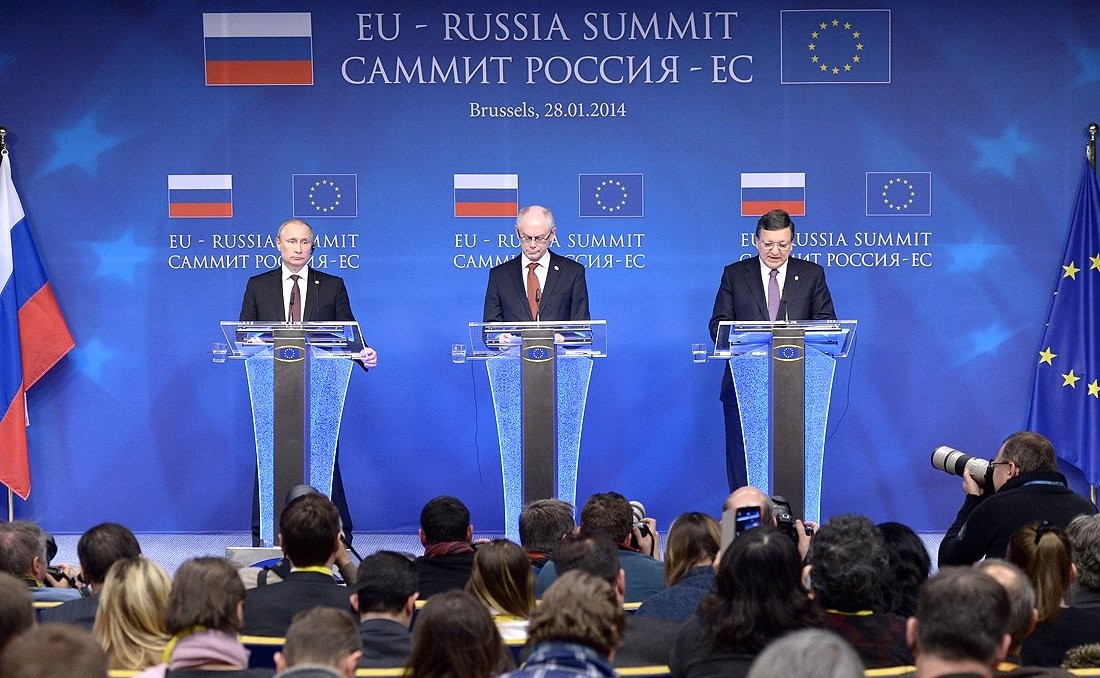
The Russian President Vladimir Putin, European Council President Herman Van Rompuy and European Commission President Jose Manuel Barroso at the joint news conference following the Russia-EU summit. Brussels, 28 January 2014 // PHOTO: Kremlin’s press office
Strange as it may seem, but it is specifically right now in these difficult circumstances that Russia has an opportunity to become a modern law-based state and find its place in the post-crisis world. Against the backdrop of ensuing global chaos, when a vision of the future is not a mandatory component of the political programme, the capability to discern a path to the future and the ability to identify an image of this future may turn out to be decisive factors. It is namely the concept of a Big Europe — from Lisbon to Vladivostok — that may offer such prospects for both Russia and Europe as a whole.
Over the past few years it has been extremely difficult to raise the issue that “moving towards Europe” is essential. Against the backdrop of aggressive anti-European propaganda in Russia, on the one hand, and the propagation in the West of the idea of the “Russian threat” for the European Union, on the other hand, the concept of a Big Europe with the participation of Russia, Ukraine, Belarus, Moldova and even, possibly, the Caucasus States, may appear utopian.
However, it is important to understand that the path to European integration is the continuation of historical Russia, the movement to European development that is natural for our country, which had been interrupted by the Bolshevik disaster and is being blocked today again by home-bred Eurasianism65G. Yavlinsky: Russia is creating a zone of instability around its borders // Vedomosti, 27 February 2014. Access (checked on: 27.02.2026).. In the case of Europe, integration with Russia and a subsequent economic, political and military strategy partnership represents the only means of survival and the acquisition of a significantly enhanced new status in global politics and economic competition with Northern America and South-East Asia in the 21st century. Standing on their own, Europe, and all the more so Russia in its own right, which is rejecting the West and considers it a source of danger, are both simply unable to withstand this competition.
In order to preserve its prospects going forward, Europe needs to expand the European lifestyle outside its existing borders. As soon as the expansionist processes stop, Europe is devoid of momentum and important content becomes bureaucratised more and more, it comes to a standstill and starts decaying. We can already observe all these phenomena today. On the other hand, Russia and Ukraine, with its own cultural and historical experience, traditions which have survived against all the odds and human potential, might exert a positive influence on the resolution of a number of European problems.
Notwithstanding the evident problems within Europe itself, leading European politicians continue to talk about the threat posed by Russia. It goes without saying that the war in Ukraine played a significant role in intensifying anti-Russian moods. Therefore one can assume that the end of this military conflict might pave the way to the rapprochement of Russia and Europe — notwithstanding the fact that this is extremely complicated and contradictory. For it is specifically the war that has been continuing for several years in the east of Europe which has undermined the European economy. In addition, Europeans have to find a solution to the acute problem with migrants, confront radicalisation in politics — both on the right and left flank — and also do their utmost to preserve the integrity of the European Union which is being proactively undermined by Eurosceptics. It is possible that awareness of such problems and attempts to resolve them will open up new prospects for Europe in relations with Russia.
In actual fact, Europe has the opportunity to change Russia specifically by cooperating with the country — through dialogue and readiness for partnership. In different periods the West maintained relations with the Soviet Union, albeit with a varying degree of complexity. However, it was specifically that readiness for dialogue in the mid-1980s which enabled the USSR and the West to turn towards each other, while this also had a serious impact on socio-political processes within our country.
The fact that the Russian-Ukrainian conflict does not only revolve around the relations between Russia and Ukraine, but also the problem of Russia’s relations with Europe, was clear long before 24 February 2022. In my article “On the Historical Future of Russia and Ukraine” in July 2021 I wrote: “For Russia-European integration offers a solution not only to the problem of relations between Russia and Ukraine, but also provides a path to a safe and prosperous future for Russia itself …”66G. Yavlinsky. On the Historical Future of Russia and Ukraine // Official website of politician and economist Grigory Yavlinsky. 19 July 2021. Access (checked on: 27.02.2026).. In this context the restoration of the Russian-European dialogue is an indispensable condition for the revival of Russian-Ukrainian relations. These processes are even possible under the current Russian regime — far from all the members of Russia’s leadership adhere to anti-Western narratives. The launch of such extremely difficult and complex processes — Russian-European and Russian-Ukrainian dialogue — will have a positive impact on the situation within Russia and will facilitate the modernisation of the state and society. There can be no doubt that the overwhelming majority of the citizens in our country are keen for such changes.
THIRD CENTRE
Over the past few years, finding itself cut off from its path to Europe, Russia has intensified its efforts to gain a stronger foothold in the Asian region. However, Russia is a country of European traditions. Unlike the Western civilisation of the 20th century based on Christian values, which created fully functional democratic institutions and a developed civil society, completely different values and institutions prevail in Eastern civilisation.
China, India, Turkey and all the countries of the Global South as a whole will never become true allies of Russia. Of course, this does not mean that a conflict is inevitable. Moreover, it is mission critical that our country maintain amicable and partnership relations with these countries. However, we should not nurture any illusions about the strategic prospects of such partnerships.
Incidentally, the issue is not about the place of Russia — in Europe or in Asia. Naturally, considering the proximity of our cultures, geographical location, scale and resource riches, one could say that Russia disposes of unique special qualities for Europe. However, when referring to these qualities, one should not emphasise the Eurasian element or even the country’s unique position as a link between Europe and Asia. The crux of our uniqueness derives from something else — the ability to elevate Europe, and in unison, elevate itself to a qualitatively new level of development that is truly global.
Today objectively Europe may be the third global development centre along with North America and South-East Asia. In this context, the withdrawal of the United States from the European arena, which took shape with the return of Trump to the White House, may be considered not as a problem, but instead as an opportunity to establish an independent European centre — a pole in global politics.
The vision of the future with Man at the centre of politics may become the ideological substantive content for such a European centre. The European concept could be counterposed against both Chinese techno-totalitarianism and the American model of life as a business.
The crisis in Europe is intensifying. The influence of historical reputational legacy, which enabled Europeans to feel for a long time that they were the centre or, at the very least, one of the centres of the Western world together with the United States, is being lost. The new geopolitical reality serving as the basis for the confrontation between the United States and China is becoming more and more evident. In these circumstances, the Old World is being transformed definitively into the global periphery.
This is also demonstrated by economic indicators: over the past two decades European business has lost ground on global markets. Whereas in past decades European companies (for example, Nokia, Nestlé or ВР) were among global leaders in terms of market capitalisation, now it is only occasionally that any European business ends up in the global top 20. In 2000 Europe accounted for almost of a third of the aggregate value and a quarter of the earnings of the 1,000 biggest companies in the world. Over 20 years these indicators have almost halved. The Economist noted: “Europe is a place for companies such as TikTok to find customers, not a base for local firms to conquer the world”67The new geopolitics of global business // The Economist, 5 June 2021. Access (checked on: 27.02.2026) // Europe is now a corporate also-ran. Can it recover its footing? // The Economist, 5 June 2021. Access (checked on: 27.02.2026)..
The lag of Europe in the high technology world is material: without the internet, it is even hard to name European companies holding serious niches on this market. Virtually all of today’s technology giants, such as Alphabet, Meta, Alibaba, Tencent, Open AI, DeepSeek, were founded outside the Old World.
The new geopolitics engenders new challenges. At some point in the past the abstract threat of Europe’s removal is acquiring real contours: literally on one side of the continent the United States is making serious claims to Greenland, while on the other side Europe is being propped up by the Turkish Great Turan. To all intents and purposes, the existential threat to the European cultural identity from the inside is being posed by the numerous communities of migrants — natives of the Middle East and Africa.
However, the key problem of Europe is not posed by external threats, but rather by the position of its modern political leaders. Several years ago the European Council on Foreign Relations published systemic research on the global balance of power named the Power Atlas68The Power atlas. Seven battlegrounds of a networked world // Official website of the European Council on Foreign Relations, December 2021. Access (checked on: 27.02.2026).. The research contains extremely sober and convincing assessments of the situation in the world and Europe’s position. However, the issues of the distribution of influence in the world and fight for influence have shifted exclusively to the area of realpolitik and the “balance of power”, whereas the value-based aspect is in general not perceived to be a factor. Furthermore, it is specifically this intangible power that is hard to measure, based on such universal human values as human freedom and rights, the freedom of creative expression and self-expression, which played a key for many years in European progress. And if the governing bodies of the European Union no longer believe in this unique power of Europe, then where exactly will this power come from?
DEFENSIVE IMPASSE
In the opinion of the well-known Bulgarian political scientist Ivan Krastev, the European Union is suffering from “vision fatigue”. The projects of the post-war world after 1989 and after the 2008 crisis have run their course, Europe knows how to survive, but “does not know how to inspire hope”, wrote Krastev in 201769I. Krastev. After Europe. Мoscow: Publishing House Delo, 2018.. The political scientist believes that as Europe is bereft of a clear vision of the future, it is becoming reactive and defensive, and not strategic.
In this context it is not surprising that after years of abortive attempts to adapt to Trump and adjust to his politics, Europeans have been compelled to change their tactics and have tried to defend themselves against the pressure of the US President.
The rupture occurred at the start of 2026. However, the turning point was not the abduction of the President of Venezuela Nicolas Maduro by the American special forces, but instead the extremely aggressive claims made by Trump over Greenland. This was expressed not only in the undue pressure of the US President on Denmark, whose territory includes Greenland according to international norms, but also in the form of threats to the entire European Union and the NATO coalition. And even though in January 2026 Trump declared at the World Economic Forum in the Swiss city of Davos that some compromise had been reached on Greenland, there was a fundamental split between the leaders of the European Union and the US President in Davos against the backdrop of the Greenland crisis. Characteristically, both European leaders and the European mass media, expressing their indignation at Trump’s actions and saying that they had reached the end of their tether, were unable to propose a single effective response to the US President.
However, proposals have appeared on how to fight Trump using his own weapons: bank on force, consider using the economy to lever pressure and conclude independent transactions, in disregard of the United States. “Now in this new world Europe is compelled to adopt a paradoxical step: if it wants to survive in empire jungles, it will have to develop its own imperial reflexes. It must be ready to expand its own space and sovereignty outwardly and fight instead with the same forces that are allying themselves with Europe’s enemies. It must learn how to use its economic power as a political weapon and support its industry strategically, in order to avoid becoming a target of espionage. And it will have to configure at the same time alliances with the countries and regions which are opposing American imperialism”, Germany’s Der Spiegel wrote immediately after the speech by Donald Trump at the conference in Davos70Donald, es reicht! Was Europa tun muss, um sich gegen Trumps Machthunger zu wehren // Der Spiegel, 22 January 2026. Access (checked on: 27.02.2026). See also: The true danger posed by Donald Trump // The Economist. 21 January 2026. Access (checked on: 27.02.2026); Hyde A. Considering a European Nuclear Deterrent // STIMSON, 20 January 2026. Access (checked on: 27.02.2026)..
The goal of such an approach is clear — to make sure that Europe becomes one of the centres of the new world, the leader in a number of key areas. However, the imitation of Trump is a pointless remedy doomed to failure. In addition, this leads to the following question: what funds and resources do Europeans plan to use to implement such a policy?
Conversations that Europe must rely on its own resources have been conducted for a long time, but to date have not delivered any results.
It was with great difficulty that the decision was adopted in summer 2025, under pressure from Trump, to increase the defence budget of the European members of NATO to 5 per cent of GDP, moreover, only by 2035. It is clear that participation in the arms race can only be accelerated by increasing taxes and reducing social programmes, in other words, by increase the burden on the public at large. The citizens of the European Union are hardly ready to do so, but it would a big mistake to accuse them of self-indulgence, infantility or a reluctance to “tighten their belts”. As a project, the European Union is based on ideas of cooperation, mutual assistance and the common good, and not war. “Guns versus butter” — such an approach derives from a different project71“Guns instead of a butter” (in German Kanonen statt Butter) — the propaganda slogan of the Third Reich (1936) intended to militarise the economy, sacrificing the prosperity of its citizens for the sake of armament. The phrase symbolises the prioritisation of military production over civilian production and is associated with the activities of the Minister of Propaganda of Nazi Germany Joseph Goebbels and Reichsminister Rudolf Hess..
Nevertheless, against the backdrop of the fighting in Ukraine, to all intents and purposes the anti-war European Union has started more and more frequently to speak, using the language of war. It is specifically the attempt of Europeans to bank on military force and “victory on the battlefield” in the Russian-Ukrainian confrontation that forced the parties for a long time to reject the idea of a ceasefire, which resulted in the loss of countless lives and the current catastrophic situation for Ukraine.
The Greenland crisis and altercation with Trump in Davis have compelled European analysts to recall again the idea of the “European nuclear umbrella”72A. Olech. A French nuclear umbrella for Europe? // Defence24.com, 23 January 2026. Access (checked on: 27.02.2026); Hyde A. Considering a European Nuclear Deterrent // STIMSON, 20 January 2026. Access (checked on: 27.02.2026). However, Europe is not North Korea which needs a nuclear bomb to defend its corner and where they live according to Juche laws. As a global leader, Europe’s objective is to prevent a nuclear disaster, and not to participate itself in dismantling the remaining mechanisms of the non-proliferation of nuclear weapons.
If we are talking seriously about a common European anti-missile defence system based on the example of America’s Golden Dome, then such a complex cannot be created on a standalone basis without effective cooperation with major countries in the European space (the projected Russian-European Anti-Missile Defence System with the participation of the United States, which was considered in 2012 and was rejected by NATO without any justification, was based on such cooperation73Vladimir Putin held negotiations with NATO Secretary-General George Robertson // Official website of the Russian President. 20 February 2001. Access (checked on: 27.02.2026).).
In this context the latest Munich Security Conference held in mid-February 2026 represented a graphic illustration of Europe’s modern view of security: the United States of America is no longer a friend, Russia remains an enemy, while the continuation of the war in Ukraine delays the inevitable military confrontation with Russia.
The focus on defence, “protection of the parameter”, reliance on military force — these are only temporary solutions for Europe intended for the period until the near-term disappearance of Trump from the White House and all his, mildly speaking, strange politics and the chaos accompanying him. However, such a calculation is naive. Already back in 2020, immediately after Trump’s defeat at the presidential elections, it was clear that this had nothing to do with the actual figure leading the republicans, but rather the political direction of travel that he embodies: “A dangerous precursor of fascism – nationalist populism in the form of Trumpism – has not been stopped: it is merely taking a break to recoup for the transition to the next offensive. The new national-populist leader will not be so awkward and vulnerable. He will hold his post not so much thanks to success as his skills. A leader, who is more balanced and less brazen than Trump, will have all the assets needed for victory”74G. Yavlinsky. Trump Wins Even in Defeat // Official website of politician and economist Grigory Yavlinsky. 18 November 2020. Access (checked on: 27.02.2026). . Even though I drafted this assessment more than five years ago, it is still fitting today when describing the prospects for the next three-four years.
That is why we need to start out from other principles in order to form the concept of a future Europe. The project closest to the original and fundamental ideas of the European Union is the renewal of the European geopolitical pole with Man at the centre. And the “European project” is not only the European Union, whose creation started after World War II, but actually Europe as the source and centre of the formation of humanist philosophy, political democracy and ideas about inalienable human rights. Europe can only preserve its identity and essence in the new environment by proposing how to resolve the problem of the lag of the individual and human consciousness behind technologies, elevating humanist ideas to a new qualitative level corresponding to the challenges of our time.
BIG EUROPE
One concept is insufficient for Europe to become an independent global centre in the current conditions — a quantitative leap is required.
Departing from the Euro-Atlantic concept, the new European project should use as a base of support Russia — a geographical neighbour that is close traditionally, culturally and mentally to European countries. Russia is an inalienable part of European civilisation, moreover, this is proved by countless volumes of historical evidence. The following striking most striking brightest and clearest:
- The European economy needs Russian resources;
- Europe may together with Russia overcome the growing technological lag from North America and China;
- An effective European security structure cannot be created without Russia.
It is not the creation of NATO without the USA, it is not a common European nuclear weapon, but instead integration with Russia that will offer Europe an independent future.
The marked aggravation in the confrontation between Russia and Europe in recent years complicates significantly any acceptance of such thoughts which would appear today to resemble pipe dreams. However, a new arms race, the destruction of the nuclear arms control mechanisms and the risk of their proliferation, the laying of mine fields, the construction of long fences on the borders of the European Union and attempts to transform Ukraine destroyed by war into a buffer zone between Russia and Europe — are not simply senseless and completely ineffective solutions — they are extremely dangerous actions that jeopardise Europe’s future in the 21st century.
For this path led initially to the creation of common economic structures and then to the formation of mutually integrated institutions in other areas of life. Consequently, in just a few years after the most terrifying catastrophe in European history Great Britain, France and Germany, which had until then been the bitterest enemies, renounced territorial disputes and fights for zones of influence and became instead real partners in a common space.
At the end of the 1980s, start of the 1990s there was a chance to continue the move towards the creation of a Big Europe. A number of politicians of the time talked about the historical opportunity to unite the continent. However, in those years the European Economic Community (predecessor of the European Union) did not have a mechanism or strategy for the admission of new poor and underdeveloped countries of Eastern Europe. In addition, the countries in Western Europe were afraid of expanding too rapidly owing to the threat of widespread migration and social instability. At the start of the 1990s Western Europe prioritised greater integration, instead of expansion. This was expressed in the signing in 1992 of the Maastricht Treaty which created the European Union and a currency union. Some West European intellectuals and politicians were concerned that the inclusion of East European countries would change Europe’s cultural and political balance and would make it less “Western”. For example, Jacques Delor, who was chairman of the European Commission from 1985 to 1995, declared: “We cannot simultaneously expand and deepen – we need to choose a path”75“The Future of Europe”, Jacques Delors’s speech at the Humboldt University, Berlin, October 1991; On 19 December 2025 during the annual final press conference the President of Russia Vladimir Putin recalled the pronouncements of the former Chancellor of the Federal Republic of Germany Helmut Kohl on the common path of Europe and Russia: “…Mr Kohl, this was in 1993, <…> said that the future of Europe, if it wants to remain an independent centre of civilisation, must at all costs be together with Russia. We complement each other naturally, we will work with each other and develop. If this does not happen, Europe will gradually disappear.” See Results of the Year with Vladimir Putin // Official website of the Russian President, 19 December 2025. Access (checked on: 27.02.2026)..
On the other hand, the destructive Belovezh Accords of 1991, which formalised the hasty break-up of the USSR, and the rejection of a common economic treaty for former Soviet republics, also did not contribute to the process of European-wide unification.
In these circumstances, progress on the path to Big Europe was stopped, the natural objective of the integration of the countries formed after the break-up of the USSR in the European space, was not resolved. Three decades later this all led to the current crisis, which is already threatening not only the break-up of the European Union and chaotic collapse of Europe, but also Russia’s disintegration, the consequences of which would affect tens of millions of people throughout the European continent.
COMMON OBJECTIVE
In summary, one might say that the key direction for a qualitative breakthrough required to preserve Europe’s integrity is the institutionalisation of European values throughout the European space from Lisbon to Vladivostok, as well as the consolidation and dissemination of the model of a non-Hobbesian state76The main ideas of Thomas Hobbes include: the natural state of humanity as a “war of all against all” where egoism prevails, there is a social contract where people give up some of their freedoms in exchange for a strong sovereign to ensure peace, and the concept of the Leviathan — the absolute power of the state (preferably a monarchy) to maintain order and security, subjugating religion in order to rule out any conflicts. The main goal is self-preservation and stability to be achieved through subordination to a strong authority., subordinate to the goal of the development and unlocking of human potential.
On the journey to this breakthrough the following critical challenges will have to be resolved: overcoming populism in politics, restoring the operating principles of a liberal democracy, conquering political entropy in the form of the malfunctioning of democratic institutions (authoritative institutions, the mass media, civil society institutions), in the form of the difference between spoken declarations of values and their practical implementation, in the form of the gulf between the state (the elites) and a country’s citizens, in the form of the focus of politicians on online mobs and not on the individual as a bearer of political subjectivity.
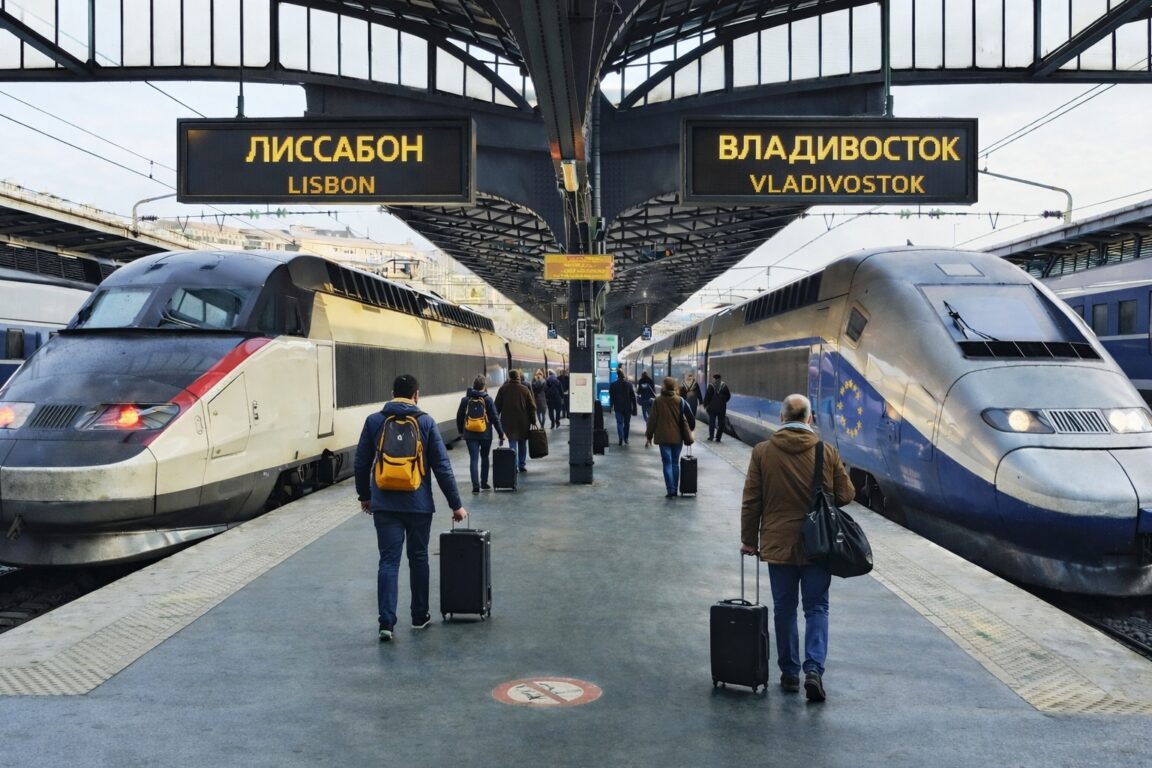
European Train Station of the Future // ChatGPT
In addition, we must not forget here the underlying principles of co-existence without which any movement on the path to a common future will be impossible. It is already at the very first stage that we must start building a common European security system based on mutual respect, an aspiration to understand the priorities and requirements of all the participants of the big European project. This also concerns both Western and Eastern Europe, including at the very least Russia, Ukraine and Belarus. And the issues of future security on the European continent should be resolved not with less, but instead possibly with more thoroughness than had been the case at the time of the signing of the Helinski Accords in 1975.
This also concerns arms control and the forms of economic cooperation, and limitations on interference in each other’s domestic policies. Vital “restraints” on new digital technologies that emphasise artificial intelligence are particularly complex and important.
The embodiment of European humanist values at a qualitatively new level, the establishment of properly functioning political, social and economic institutions based on these values, the retention in this way of human identity in the era of high technologies and artificial intelligence — this is the objective that should unite the efforts of Europe and Russia in the global world of the 21st century.