
Why did the US attack Caracas and seize Maduro? The answer to this question is considerably simpler than the theories being published. The entire matter lies in the fact that Venezuela possesses the world’s largest oil reserves — over 300 billion barrels — and Donald Trump wants Venezuelan oil to be controlled by the United States in one way or another, something he has never concealed.
The official justifications for the American operation — the fight against drug trafficking, the removal of a criminal dictator from power, the struggle for democracy and so forth — are nothing more than a screen concealing the essence: behind the US attack on Venezuela and the seizure of the country’s president with his wife stands an attempt to gain access to Venezuelan oil and to what the American administration considers a super-profitable business. Incidentally, Trump himself spoke about this quite openly very recently: on 18 December he stated that he wanted “getting land, oil rights, whatever we had” back from Venezuela, and on 3 January, immediately after the operation in Caracas, Trump announced that the US intended to “attract the largest oil companies, which will invest billions of dollars and begin to bring profit to the country”. The future of Venezuela — the fate of the country and its citizens — is not even being discussed.
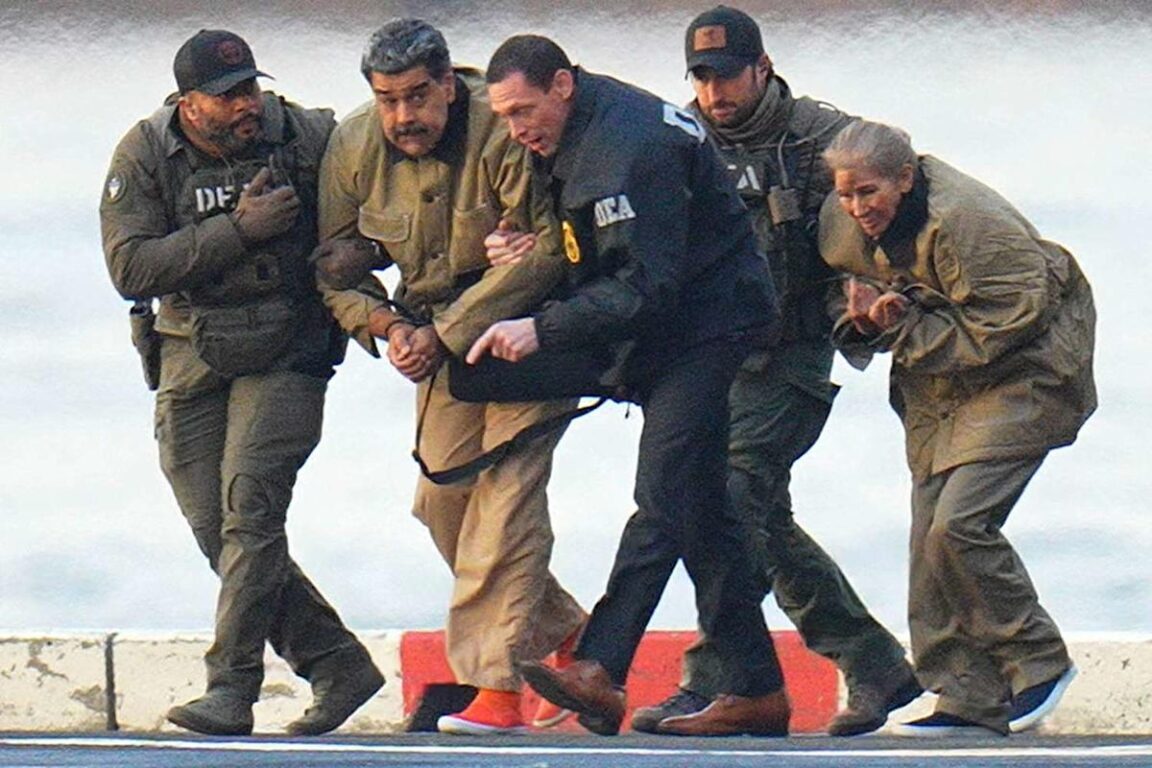
Nicolas Maduro and his wife, Cilia Flores, are seen in handcuffs after landing at a Manhattan helipad, escorted by heavily armed Federal agents as they make their way into an armored car en route to a Federal courthouse in Manhattan // Photo by XNY/Star Max/GC Images
All of this certainly does not mean that everything in Venezuela had been, to put it mildly, cloudless. The country has had an extremely high level of inflation, an acute budget deficit and enormous state debt. Despite having the world’s largest oil reserves, extraction volumes have been minimal. Over ten years the country has lost almost three-quarters of its GDP, and over 8 million Venezuelans have emigrated. It is widely known that Maduro has been holding onto power by any means, including terror. After numerous violations and falsifications in the 2024 presidential elections, Maduro deprived himself of what little popular legitimacy he had still retained. The catastrophic results of his presidency in a country impoverished by barren ideology, incompetence, violence and corruption have long since become an argument in favour of his resignation.
However, none of this can legitimise the actions of the United States. Military invasion of another country and the abduction of its leader, however much of a villain he may be, demonstrates the failure of international law and the destruction of world order, undermines the fundamental rules governing relations between countries and, consequently, makes the world even more dangerous.
What follows from this?
The events in Venezuela at the beginning of 2026 are yet another vivid confirmation that the former world order, which people had tried to establish after World War II on universal human values, is collapsing. Article 2, Paragraph 4 of the UN Charter runs: “All Members shall refrain in their international relations from the threat or use of force against the territorial integrity or political independence of any State, or in any other manner inconsistent with the Purposes of the United Nations.” And although it is not the first time that the United States violates this paragraph, and not only the United States, now it seems that all of this is finally receding into the past — international institutions and international law are ceasing to function, and the preservation of human life is no longer the principal objective in world politics.
The US National Security Strategy, published by the Trump administration at the end of 2025, refers back to the Monroe Doctrine. But this logic is based on considerations formulated in the distant past of 1823 by US President James Monroe — in a completely different era, when American might knew no equal in the Western Hemisphere. That world no longer exists. And whilst 200 years ago the issue was about non-interference by European powers in affairs on the two American continents, today’s postmodernist version of the Doctrine speaks of the inadmissibility of interference in US activities in realisation of its interests now virtually anywhere in the world. “We absolutely need Greenland”, Donald Trump declared immediately after Maduro’s abduction.
Stephen Miller, Deputy Chief of Staff at the White House and Adviser to the US President on Homeland Security, puts it quite directly: “The real world is governed by force and power. These are the iron laws of the world since the beginning of time”. In this context, Trump’s latest statements are already quite unambiguous: “Cuba is a failed state, and we want to help its people”, the American President said. “Cuba is going to be something we’ll end up talking about”. Besides Greenland and Cuba, Trump is also talking about Canada, Panama, Mexico and Colombia.
One must understand that Donald Trump is making such decisions, as with Venezuela, without the approval and indeed without any participation of the US Congress, and still less is he attempting to gain any international legitimacy.
Meanwhile, the American press, ostensibly in opposition, is seeks mutual understanding with Trump and approves his actions, calling the seizure of Maduro “a major victory for the defence of American interests”. American elites are also adapting to Trump’s policies: Elon Musk published a photo of a dinner with Donald Trump after Maduro’s capture and wrote that “2026 is going to be amazing”.
Today’s political Europe is attempting to go along with Trump’s lead and is not offering its own vision of the future.
Moscow is speaking with Trump in the language of business he understands, the language of deals. Therefore, in negotiations with the American President, Russia is achieving greater success than other countries, whilst pushing Washington further and further away from the Ukrainian issues.
And for China, what is happening in Venezuela is, certainly, a question about Taiwan’s prospects.
Beijing will also want to follow the American example and take advantage of the privilege of making exceptions to international law at its own discretion. The operation in Venezuela became one of the most popular topics on Chinese social networks at the beginning of 2026.
One is forced to acknowledge that the horizon of understanding prospects and planning amongst contemporary acting politicians is extremely narrow, and their conception of where they are leading the world is extremely vague. The events of recent days confirm that further world political processes will develop without any legal or value-based guidelines (see In-Between Times: On the Titanic. On the problems and threats of the impending era): when force replaces law and rights, and money is the sole meaning and purpose of politics. But this is not a “new world order”, this is chaos, a progressive world disorder, where the only instrument of interaction is weapons (see New World Disorder. On the collapse of the international order formed after the end of World War II and the risks of a major global conflict). And when people say that now global politics will be centred around countries possessing nuclear weapons, this is a retreat into the past — to an arms race. Only with the difference that in modern conditions nuclear weapons will proliferate at great speed and will soon become accessible to very many countries.
The processes of chaos are being actively supported by digital technologies and social networks, through which mass consciousness is cunningly and selectively blocked, and cynicism is formed and spread. All of this leads to absolute self-confidence coupled with complete incapacity to understand the political and social phenomena taking place.
Leading Western media are writing in bewilderment: “what will happen next remains extremely unclear at this point”.
An 80-year epoch has come to an end. The main question today is what will happen next? If we do not attempt to find an answer to this question right now, then the interests of our generation, our children and grandchildren will be arbitrarily and objectively turned to dust.
What should we do?
Firstly, Russia and Ukraine must immediately sign a ceasefire agreement. Ultimately, they will have to negotiate between themselves. Is it really still not clear that one cannot rely on anyone?! In this world everyone is solving their own problems, and the wellbeing and preservation of the lives of the citizens of our countries are definitely not on the list of priority objectives of either American or European policies.
Secondly, one must not harbour illusions that the US President «will come to you and put things in order in your dictatorships». Donald Trump has pronounced business interests, which are in no way hindered by the form of governance.
Thirdly, one can emerge from chaos only if one understands and sees where to go. The future must be built so that people are at the centre — their lives, freedom and creativity. The principled subordination of the state, AI and digital technologies to human interests is essential. Only in this way can one overcome the current crises in the US, Europe and Russia. Moreover, this is the only path to preventing Russia’s disintegration and creating conditions for modern development. This is the path to a Greater Europe of the second half of the 21st century from Lisbon to Vladivostok, to a new future built around people.